By: Madeline Miele
Edited By: Stephen Shiwei Wang
Introduction
On July 29, 2025, the Environmental Protection Agency (EPA) Administrator, Lee Zeldin, announced at a car dealership in Indiana, a proposal to rescind the 2009 Endangerment Finding citing that this move will “end $1 trillion taxes on American businesses and families” and save more than $54 billion annually.1 Zeldin expressed that, “with this proposal, the Trump EPA is proposing to end sixteen years of uncertainty for automakers and American consumers.”2 During the press release, the discussion mainly surrounded business efforts and the economy with limited dialogue on air pollution and how this new proposal will help protect people’s health. Then, on February 12, 2026, the EPA made the single largest deregulatory action in U.S. history and finalized the rescission of the Endangerment Finding.3 This paper will talk about the Endangerment Finding, how it became established, the evidence surrounding that, and what this rescission means going forward.
Endangerment Finding Established
The Endangerment Finding is in response to Massachusetts v. EPA, 549 U.S. 497 (2007). Figure A, below, details a specific timeline that led to the formation of the Endangerment Finding, showing the duration of this administrative process. This court case included Massachusetts and several other states petitioning the EPA to regulate emissions of carbon dioxide and other gases that contribute to global warming from new motor vehicles. Massachusetts argued that the EPA was required to regulate these greenhouse gases by the Clean Air Act (CAA), under section 202, which Congress states must regulate “any air pollutant” that can “reasonably be anticipated to endanger public health or welfare.”4 The EPA denied the petition, claiming the CAA does not authorize the EPA to regulate greenhouse gas emissions (GHG). Massachusetts filed another petition towards the EPA asking it to either determine carbon dioxide “may reasonably be anticipated to endanger public health or welfare” or say why it is not such a pollutant.5 The EPA argued that they are allowed to exercise judgment and that carbon dioxide is not an air pollutant within the meaning of CAA Section 202.
Ultimately, the Supreme Court ruled in favor of Massachusetts and found that GHGs are air pollutants; the EPA is obligated to act and base the decision on a consideration of “whether GHG contributes to climate change.”6 In their decision, the court mentioned Georgia v. Tennessee Copper Co (1907), citing that Massachusetts has a quasi-sovereign interest in protecting its territory, creating its standing to sue EPA for potential damage by global warming. Another court case, Lujan v. Defenders of Wildlife (1992), was mentioned with supporting their decision of Massachusetts having standing due to the injury faced by rising sea levels that are altering the state’s coast.7
This ruling of GHG qualifying as pollutants under the CAA directed the EPA to determine whether these gases endanger public health and welfare. On December 7, 2009, after years of scientific research, the EPA signed two findings under the CAA Section 202(a). One was the Endangerment Finding, which found that six key GHG – carbon dioxide, methane, nitrous oxide, hydrofluorocarbons, perfluorocarbons, and sulfur hexafluoride – meet the endangerment criteria of threatening the public health and welfare of current and future generations. The second, called the “Cause of Contribute Finding,” determined that emissions from new motor vehicles contribute to air pollution. These findings provided the legal basis and gave the EPA the authority to regulate GHG emissions from vehicles and industrial sources.8 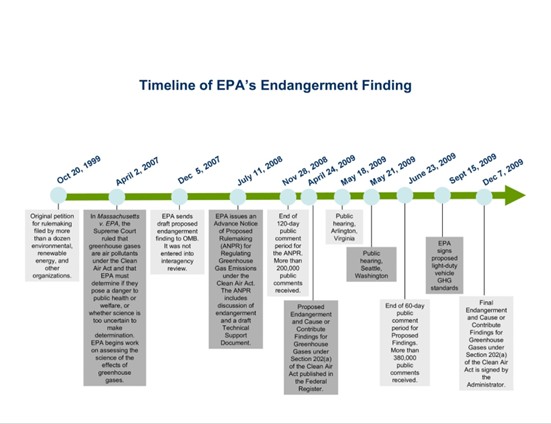
Figure A: EPA Endangerment Finding Timeline 9
Endangerment Finding Evidence
It is important to mention the science and evidence that led to the establishment of the Endangerment Finding. These findings are explicitly explained in the 195+ page document, “Endangerment and Cause or Contribute Findings for Greenhouse Gases under section 202(a) of the Clean Air Act.” This technical support document includes a robust scientific record, and its primary purpose was to provide the scientific information regarding GHG emissions so the then-EPA Administrator could make a decision on whether these findings show an endangerment to the public health or welfare. The conclusions from this document were drawn from assessment reports of the Intergovernmental Panel on Climate Change (IPCC), the U.S. Climate Change Science Program (CCSP), the U.S. Global Change Research Program (USGCRP), and the National Research Council (NRC). The process included an extensive review of decades of scientific research and peer-reviewed assessment reports summarizing thousands of individual climate science studies.10 There were many trends and findings from the technical document that were observed. Among the most notable findings documented in the technical support document, several stand out as significant:
- Greenhouse gases, once emitted, can remain in the atmosphere for decades to centuries. This means that their concentrations become well-mixed throughout the global atmosphere regardless of emission sources, and their effects on climate change are long-lasting. This is critical because it means that even if emissions stopped today, the warming effects already set in motion would continue for generations.11
- “Warming of the climate system is unequivocal, as is now evident from observations of increases in global average air and ocean temperatures, widespread melting of snow and ice, and rising global sea level.”12
- “Coastal communities and habitats will be increasingly stressed by climate change impacts interacting with development and pollution.”13
- “Climate change will likely further constrain already overallocated water resources in some regions of the United States, increasing competition among agricultural, municipal, industrial, and ecological uses.”14
- A report from the CCSP found that climate change has the potential to accentuate the disparities already evident in the American health care system, as many of the expected health effects are likely to fall disproportionately on the poor, the elderly, the disabled and the uninsured. This finding is significant because it shows that climate is not just an environmental issue but also includes systemic problems.15
These findings were documented on December 7, 2009, nearly seventeen years ago, and the conditions they describe remain observable today. Arguably, they have only intensified in the years since. According to a 2018 study led by Stanford Woods Institute for the Environment, since the Endangerment Finding was established, scientific evidence has increased dramatically for each climate change area noted in the document, as concluded by 16 authors across 15 research institutions.16 Chris Field, Stanford Woods Institute for the Environment Director, said “there is no question that public health and welfare are endangered by climate change and we know that with much more confidence now than we did in 2009.”17 Given the magnitude of what the Endangerment Finding included, it is beneficial to examine the recent rescission.
What the Rescission Means
The rescission, declared on February 12, 2026, is centered around economic relief and the restoration of consumer choice. It rescinds the 2009 findings of contribution and endangerment and repeals all GHG emission standards for new motor vehicles. The EPA claims that this action will deliver over $1.3 trillion in relief for American families and businesses, projecting over $2,400 in savings on new cars and trucks.18
In the rescission final rule, the EPA under the Trump administration took the position on four areas. First, the Agency never had the legal authority under CAA section 202(a) to prescribe emission standards in response to global climate change concerns. Their argument is that the CAA was written to address local and regional air pollution. Second, the EPA concluded that even if all GHG emissions from every vehicle in the U.S. were eliminated, it would have no meaningful impact on global temperature or sea level rise. In the agency’s view, it made the entire regulatory program pointless. Third, they highlight the overturn of the 40-year-old Chevron Doctrine through Loper Bright Enterprises v. Raimondo (2024), which eliminated federal agencies of their power to interpret ambiguous laws. Under this, the EPA states that this is a decision that belongs to Congress, not the EPA. Overall, the rescission did not rule directly on the science, and the EPA did not base its action on any new scientific finding, rather it questioned the statutory authority processes.19 With there not being much scientific basis or support surrounding climate change impacts in the rescission, it is important to bear in mind what remains and the implications of the single largest deregulatory action in United States history. Since the rescission, legal action has already been taken from multiple stakeholders.
Litigation Responses
The language of the rescission is familiar with what brought this country to determine the Endangerment Finding in the first place. The EPA made a very similar argument before the Supreme Court rejected it in Massachusetts v. EPA (2007). Then, the agency claimed it lacked authority to regulate GHG under the CAA, and the Supreme Court disagreed. Now, almost twenty years later, the EPA under the Trump administration is making that argument again. But the difference is that the legal landscape has shifted with them highlighting legal cases, West Virginia v. EPA (2022) and Loper Bright Enterprises v. Raimondo (2024), which did not exist in 2007.
The actions taken after the rescission were swift. A coalition of 24 states filed suit against the Trump administration over its decision to revoke the Endangerment Finding, the backbone of virtually all U.S. climate regulations.20 Not only have states started to sue, but many environmental groups have as well. One lawsuit was brought by the American Public Health Association, American Lung Association, Center for Biological Diversity, Environmental Defense Fund (EDF), Natural Resources Defense Council, Sierra Club, and 11 other public health and environmental organizations. In a press release, Brian Lynk, Senior Attorney, Environmental Law & Policy Center said,
“The EPA is attempting to completely disavow its statutory authority to regulate greenhouse gases from motor vehicles. After two decades of scientific evidence supporting the 2009 finding, the agency cannot credibly claim that the body of work is now incorrect. This reckless and legally untenable decision creates immediate uncertainty for businesses, guarantees prolonged legal battles, and undermines the stability of federal climate regulations. The EPA cannot be permitted to abandon its responsibility to protect public health and welfare.”21
Additionally, in August of 2025, following the EPA’s proposal to rescind the Endangerment Finding, the EDF and the Union of Concerned Scientists (UCS) filed a lawsuit against the Trump administration under the Federal Advisory Committee Act. This lawsuit “challenged the Trump administration’s use of a secretively convened group of climate skeptics, [called the Climate Working Group], to prepare a now widely disparaged report in its attempt to undo the Endangerment Finding.”22 A federal judge ruled that the administration violated the law by not having open meetings, public records, or balanced representation of viewpoints. With this, the judge ordered the Trump administration to turn over their records of the Climate Working Group. As of March 16, 2026, the EDF and USC are releasing more than 100,000 pages of government records that they received, which are now available to the public. These records suggest the Trump administration prioritized its own goals over the established scientific process in an effort to roll back climate-related findings. This has drawn major criticism from public health and scientific communities.23
Conclusion
Taking steps back, like rescinding the Endangerment Finding, is the exact opposite of what should be happening. The climate crisis is a systemic problem that is going to require assistance from multiple stakeholders. The Trump administration is trying to claim this move will save billions of dollars, but research suggests that stalling action on climate change regulations leads to greater costs over time.24 This paper examined the Endangerment Finding process then, in 2009, and now. The arguments of the pushback before the regulation were established in 2009, and the current stance from the Trump administration is similar. This shows how the certainty of regulations depends on who is holding the federal government. The repeal, despite the overwhelming amount of scientific evidence, reflects a shift in priorities from evidence-based policymaking to policies that fit an ideology. This displays the institutional weakness with reversing a foundational scientific and climate finding that has been in place for sixteen years. This repeal will endanger people’s health, and the climate crisis will persist. These disasters are not isolated events, but connected consequences of a warming planet. There will still be dangerous floods, record-breaking heat, wildfires and extreme weather, even as businesses allegedly flourish under the repeal of the Endangerment Finding.25 The business-forward ideology comes at the expense of millions of people who will bear the burden of this decision.
Work Cited
- EPA. 2025a. “EPA Releases Proposal to Rescind Obama-Era Endangerment Finding, Regulations That Paved the Way for Electric Vehicle Mandates | US EPA.” US EPA. July 29, 2025. https://www.epa.gov/newsreleases/epa-releases-proposal-rescind-obama-era-endangerment-finding-regulations-paved-way.
- Ibid.
- EPA. 2025b. “Final Rule: Rescission of the Greenhouse Gas Endangerment Finding and Motor Vehicle Greenhouse Gas Emission Standards under the Clean Air Act | US EPA.” US EPA. November 17, 2025. https://www.epa.gov/regulations-emissions-vehicles-and-engines/final-rule-rescission-greenhouse-gas-endangerment#additional-resources.
- Oyez. 2019. “Massachusetts v. Environmental Protection Agency.” Oyez. 2019. https://www.oyez.org/cases/2006/05-1120.
- Justia. 2007. “Massachusetts v. EPA, 549 U.S. 497 (2007).” Justia Law. 2007. https://supreme.justia.com/cases/federal/us/549/497/.
- Oyez. 2019. “Massachusetts v. Environmental Protection Agency.” Oyez. 2019. https://www.oyez.org/cases/2006/05-1120.
- Justia. 2007. “Massachusetts v. EPA, 549 U.S. 497 (2007).” Justia Law. 2007. https://supreme.justia.com/cases/federal/us/549/497/.
- EPA. 2021. “Endangerment and Cause or Contribute Findings for Greenhouse Gases under Section 202(A) of the Clean Air Act.” Www.epa.gov. May 11, 2021. https://www.epa.gov/climate-change/endangerment-and-cause-or-contribute-findings-greenhouse-gases-under-section-202a#action.
- EPA. 2021b. “Greenhouse Gas Endangerment Finding Timeline | US EPA.” US EPA. May 11, 2021. https://www.epa.gov/climate-change/greenhouse-gas-endangerment-finding-timeline.
- EPA. 2009. “Technical Support Document for Endangerment and Cause or Contribute Findings for Greenhouse Gases under Section 202(a) of the Clean Air Act.” Washington, DC: U.S. EPA. https://www.epa.gov/sites/default/files/2021-05/documents/endangerment_tsd.pdf.
- Ibid.
- Ibid.
- Ibid.
- Ibid.
- Ibid.
- Duffy, Philip B., Christopher B. Field, Noah S. Diffenbaugh, Scott C. Doney, Zoe Dutton, Sherri Goodman, Lisa Heinzerling, et al. 2018. “Strengthened Scientific Support for the Endangerment Finding for Atmospheric Greenhouse Gases.” Science363 (6427). https://doi.org/10.1126/science.aat5982.
- Stanford Woods Institute for the Environment. 2018. “Scientific Basis for EPA’s Endangerment Finding Is Stronger than Ever.” Stanford Doerr School of Sustainability. Stanford University. 2018. https://sustainability.stanford.edu/news/scientific-basis-epas-endangerment-finding-stronger-ever.
- U.S. Environmental Protection Agency. 2026a. “Fact Sheet: EPA Delivers Single Largest Deregulatory Action in U.S. History, Major Cost Savings for Americans.” EPA 420-F-26-004. February 2026. https://nepis.epa.gov/Exe/ZyPDF.cgi?Dockey=P101HV02.pdf.
- U.S. Environmental Protection Agency. 2026b. “Rescission of the Greenhouse Gas Endangerment Finding and Motor Vehicle Greenhouse Gas Emission Standards Under the Clean Air Act.” Federal Register 91 (32): 7686–. February 18, 2026. https://www.govinfo.gov/content/pkg/FR-2026-02-18/pdf/2026-03157.pdf.
- Friedman, Lisa. 2026. “24 States Sue E.P.A. Over Climate Change Decision.” The New York Times, March 19, 2026. https://www.nytimes.com/2026/03/19/climate/epa-endangerment-states-lawsuit.html.
- Drajem, Mark. 2026. “NRDC and Coalition Sue over Endangerment Rollback and Climate Protections.” Nrdc.org. February 18, 2026. https://www.nrdc.org/press-releases/nrdc-coalition-sue-endangerment-rollback-climate-protections.
- Stein, Sharyn. 2025. “EDF, UCS File Lawsuit against Trump Administration Secret Convening of Climate Skeptics, Use of Their Hidden ‘Science’ Report in Attempt to Overturn Endangerment Finding.” Environmental Defense Fund. August 12, 2025. https://www.edf.org/media/edf-ucs-file-lawsuit-against-trump-administration-secret-convening-climate-skeptics-use-their.
- EDF. 2026. “Climate Working Group Records.” Environmental Defense Fund. March 16, 2026. https://www.edf.org/climate-working-group-records?tags=CWG+NCA5+Critique+Report.
- Alberti, Caroline. 2024. “The Cost of Inaction.” Climate Policy Initiative. January 4, 2024. https://www.climatepolicyinitiative.org/the-cost-of-inaction/.
- WWF. 2023. “Is Climate Change Increasing the Risk of Disasters?” World Wildlife Fund. 2023. https://www.worldwildlife.org/resources/explainers/is-climate-change-increasing-the-risk-of-disasters/.