By: Xinyi Liang
Edited By: Rose Kores
Introduction
The Clean Air Act established a foundational framework for environmental governance in the United States, centering on pollution control, public health protection, and a federal-state enforcement structure. Modern climate governance extends beyond reducing emissions from industrial and mobile sources. It increasingly addresses questions of who bears environmental burdens, who benefits from transition policies, and whether decarbonization can be aligned with labor protection, public health, and social justice. The New York State Climate Action Council Scoping Plan reflects this expanded vision. It treats climate transition not only as an emissions problem but also as a labor, health, and equitability issue, representing a significant departure from the Clean Air Act framework. This broader scope introduces new implementation challenges. While the Scoping Plan advances beyond the Clean Air Act by incorporating just transition, disadvantaged communities, and public health into climate governance, its feasibility is still constrained by structural barriers.
The Clean Air Act: The Traditional Framework of Pollution Control and Compliance
The Clean Air Act was designed to control emissions from industrial and mobile sources, improve air quality, and protect public health and welfare. The 1970 version established the Environmental Protection Agency (EPA) and required major reductions in new vehicle emissions to address pollutants such as nitrogen oxides and ozone.1
Institutionally, the Clean Air Act follows a federal-state regulatory model. The federal government sets standards, while state and local governments implement them through permits, monitoring, inspections, and State Implementation Plans. The federal government serves as a backstop, reviewing state actions, taking independent action when necessary, and filing accountability lawsuits when state responses are insufficient. Under this framework, traditional regulation operates strictly on standard-setting, compliance, and enforcement.2,3
The 1990 amendments strengthened this framework by introducing clearer accountability and more specific implementation tools. Compared with the earlier period, the amendments imposed stronger standards, elevated several violations from misdemeanors to felonies, and added more detailed requirements for hazardous air pollutants and fuel regulation.4 These changes made the act more ambitious and enforceable, but they remained within a traditional air pollution control model.4,5
The Clean Air Act was originally designed to reduce pollution, improve air quality, and protect public health through standards, compliance, and federal-state regulation. It was not designed to directly address labor equity, just transition, or broader decarbonization strategy.
Why Pollution Control Was Not Enough: Inequality, Sacrifice, and Uneven Burdens
Pollution and pollution control do not occur equally across regions and populations. They involve pollution transfer, spatial inequality, and disproportionate costs borne by marginalized and minority communities, all of which are visible within older air policy frameworks. Especially since clean air protection often remains a privilege of stronger states and cities, the Clean Air Act framework does not provide equal protection to all affected regions and lacks detailed implementation mechanisms for minority communities. When compensation or transition support is absent, environmental enforcement can appear inequitable.
Louisiana’s Cancer Alley illustrates how sacrifice zones operate in the United States.6 The St. James Parish community is surrounded by approximately 200 fossil fuel and petrochemical operations, reportedly the largest concentration of such facilities in the Western Hemisphere.6 For decades, residents have faced severe health threats. However, the Louisiana Department of Environmental Quality and the EPA, which were supposed to be two of the most authoritative agencies in Louisiana’s clean air initiative, have made limited progress in protecting local rights. The area spans 85 miles and contains hundreds of factories with only one or two air quality monitors.7 Most residents of the parish are low-income African Americans, demonstrating that sacrifice zones are not only shaped by geography but also racial inequality.8 Environmental policy cannot be fully evaluated by emissions targets or legal accountability. Policy must also address who bears the burden of pollution, who benefits from industrial development, and whether environmental improvement in one place depends on sacrifice elsewhere.
The New York Scoping Plan: Expanding Goals From Emissions to Socioeconomic Equity
As one of the largest states in the country, New York has devoted substantial resources to meeting and exceeding federal emission requirements. The New York State Climate Leadership and Community Protection Act is a law enforced by the state in 2019. It aims for a 40% reduction in greenhouse gas emissions by 2030 and at least an 85% reduction by 2050, compared with 1990 levels.9 The act established the Climate Action Council and the Climate Justice Working Group and coordinates agencies across the environment, public health, labor, and transportation sectors.10 The 2022 Scoping Plan highlights the scale of this transition. Buildings account for 32% of current emissions, transportation accounts for 28%, and electricity for 13%. These figures indicate that the net-zero goal requires cooperation across departments.
The Scoping Plan also reframes climate policy as an industrial and labor market transition. It does not treat clean energy transition solely as a restriction on existing industries, but also as a process that generates new investment, employment, skills training, and local development opportunities. The “Just Transition” section explicitly states that displaced workers should receive skills assessment, training, re-employment support, and coordinated funding and incentives.11
Chapter 7 on “Just Transition” and the Scoping Plan’s executive summary make clear that New York State treats structural climate solutions as an economic and labor strategy.11 The strategy aims to create new opportunities while protecting workers and communities affected by structural change. It treats climate equity, just transition, and public health as guiding pillars across the policy framework. Emissions reduction pathways must therefore consider who is harmed, who benefits, and who may be excluded from new opportunities. The plan includes displaced worker support, training programs, career pathways, an Office of Just Transition, and a Worker Support and Community Assurance Fund. These measures can support workers from traditional energy sectors and expand access for new entrants into low-carbon occupations. It also commits to creating stable, well-paying union jobs as part of the transition.
According to its optimistic projections, the Scoping Plan estimates that the clean energy transition could potentially generate an additional 211,000 jobs by 2030, and mandates that at least 35% of benefits flow to disadvantaged communities.11 Whether these targets can be translated into labor market outcomes remains a central implementation challenge, which the following section examines.
On April 2, 2026, Governor Kathy Hochul announced a $50 million fund to equip workers with the skills needed for careers in efficient and renewable energy.12
The Scoping Plan expands environmental policy beyond pollution control. Instead of attaching labor concerns as a subordinate, it integrates labor, health, equity, and transition planning into the larger policy design. The state is also required to prioritize reductions in greenhouse gases and co-pollutants in these communities and avoid imposing disproportionate burdens through new policies. The New York Department of Environmental Conservation claimed to use $3 million in grants supporting such community-led monitoring initiatives.13
Equity functions as a cross-sector constraint rather than a separate welfare measure. Each sector strategy must consider whether a policy delivers more benefits to disadvantaged communities or shifts more costs onto them; concentrates pollution burdens in the most affected places; or directs green jobs, training, and infrastructure primarily toward people and places that already have more resources.
The core problem in disadvantaged communities is often not statewide emissions levels, but disproportionately high local exposure, since policies focused on statewide averages can obscure unequal outcomes. The Scoping Plan addresses this by including community air monitoring, local pollution reduction measures, and health burden assessments in its implementation framework to reduce local pollution exposure from buildings and transportation. Statewide Solar for All illustrates this approach.14 The program provides eligible low-income households with electricity bill savings through community solar at no cost, with monthly credits applied automatically. The Public Service Commission processed the compensation schedules for the 2024-2026 program. This means New York State is not only encouraging broad solar adoption but is also running a distributed solar savings program specifically for low-income households.14
Compared with the Clean Air Act, the Scoping Plan reflects a significant expansion in policy goals. Environmental policy is no longer defined only by cleaner air, but is also defined by whether the transition is equitable, inclusive, and socially sustainable.
The Challenge of Turning Climate Justice Goals into Real Governance
The most difficult part of the Scoping Plan is implementation. A comparison of the Clean Air Act and the Scoping Plan suggests that New York State’s central challenge is not setting goals but converting an ambitious cross-sector vision into binding governance. Chapter 23, for example, describes how the state works with the Department of Environmental Conservation and the EPA to track and attribute greenhouse gas emissions and report findings under the Climate Act.11 However, monitoring alone does not guarantee implementation—the state must still translate the Scoping Plan into enforceable regulations, stable funding, and workable local arrangements. Without sustained coordination across agencies, commitments to supporting and retraining displaced workers, delivering benefits to affected communities, and improving public health risk remain policy aspirations rather than real outcomes.
New York State’s labor projections may be overly optimistic. While these estimates suggest the creation of 211,000 jobs, they do not indicate whether displaced fossil-fuel workers can realistically access these positions. The central barrier is not retraining alone but spatial mismatch. Many green jobs are not located near existing fossil-fuel labor markets. As illustrated in Figure 1, a Nature Communications study finds that 98.97% of extraction workers would not transition into green jobs, and even if all green jobs were located in the same areas, the transition rate would still only be 13.7%.15 Job quality presents an additional concern. The National Bureau of Economic Research posits that fossil-fuel industries provide relatively high wages for workers without college degrees, while replacement jobs in the transition may not offer comparable pay, benefits, or stability.16 Therefore, more green jobs does not automatically mean a just transition for existing workers.
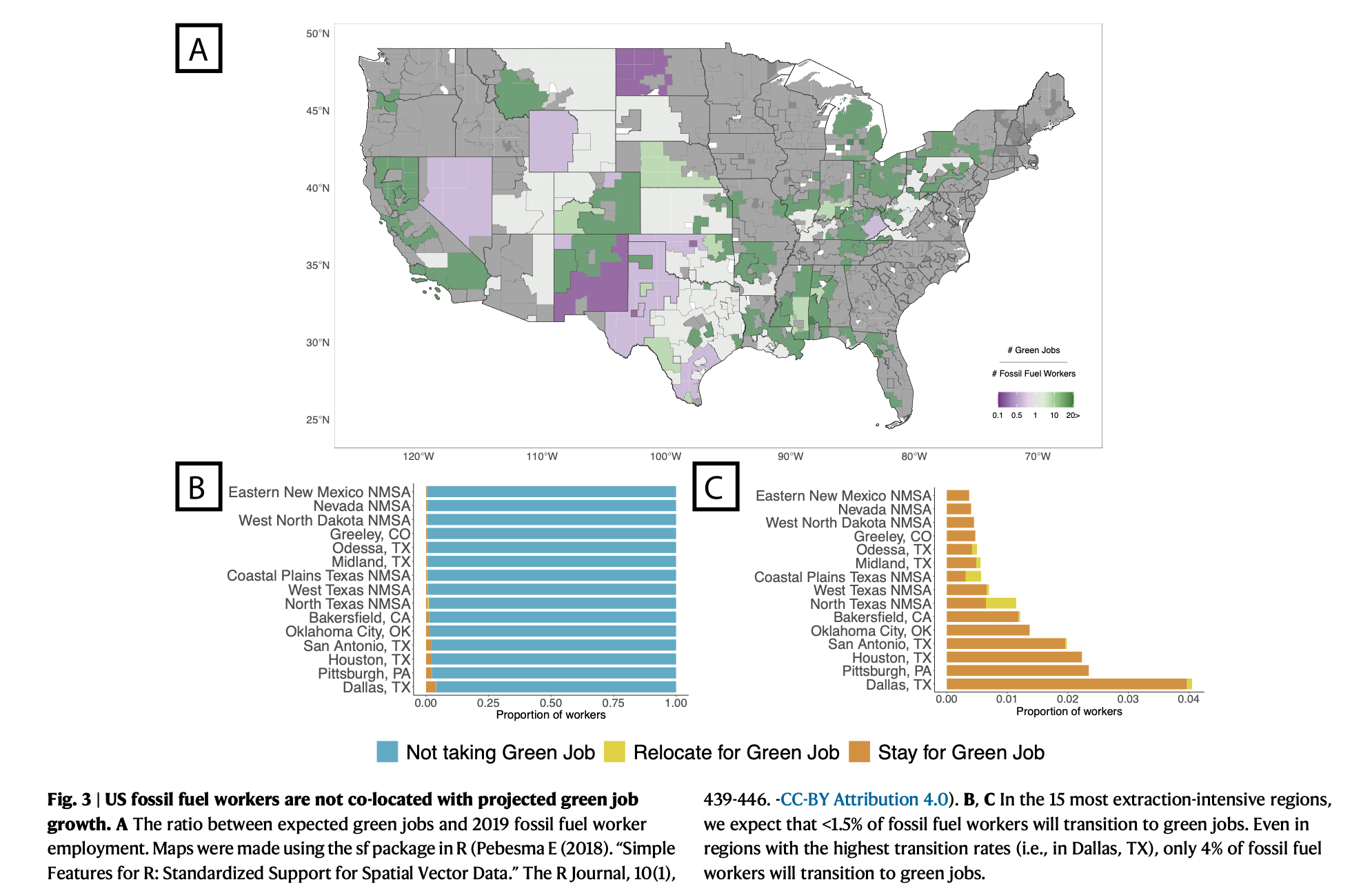
Figure 1
Regarding grid reliability during decarbonization, relying entirely on solar and wind power remains uncertain. Beyond nuclear power, imports, and hydropower, suppliers would still depend on additional unidentified zero-emission resources to cover serious electricity shortfalls during extreme weather.15 Figure 2 shows that under New York State’s current decarbonization pathway, the system shows clear vulnerability, particularly in winter and high-temperature summer scenarios.16 The firm zero-emission capacity needed to maintain reliability may be 61% to 105% higher than current planning assumptions.17
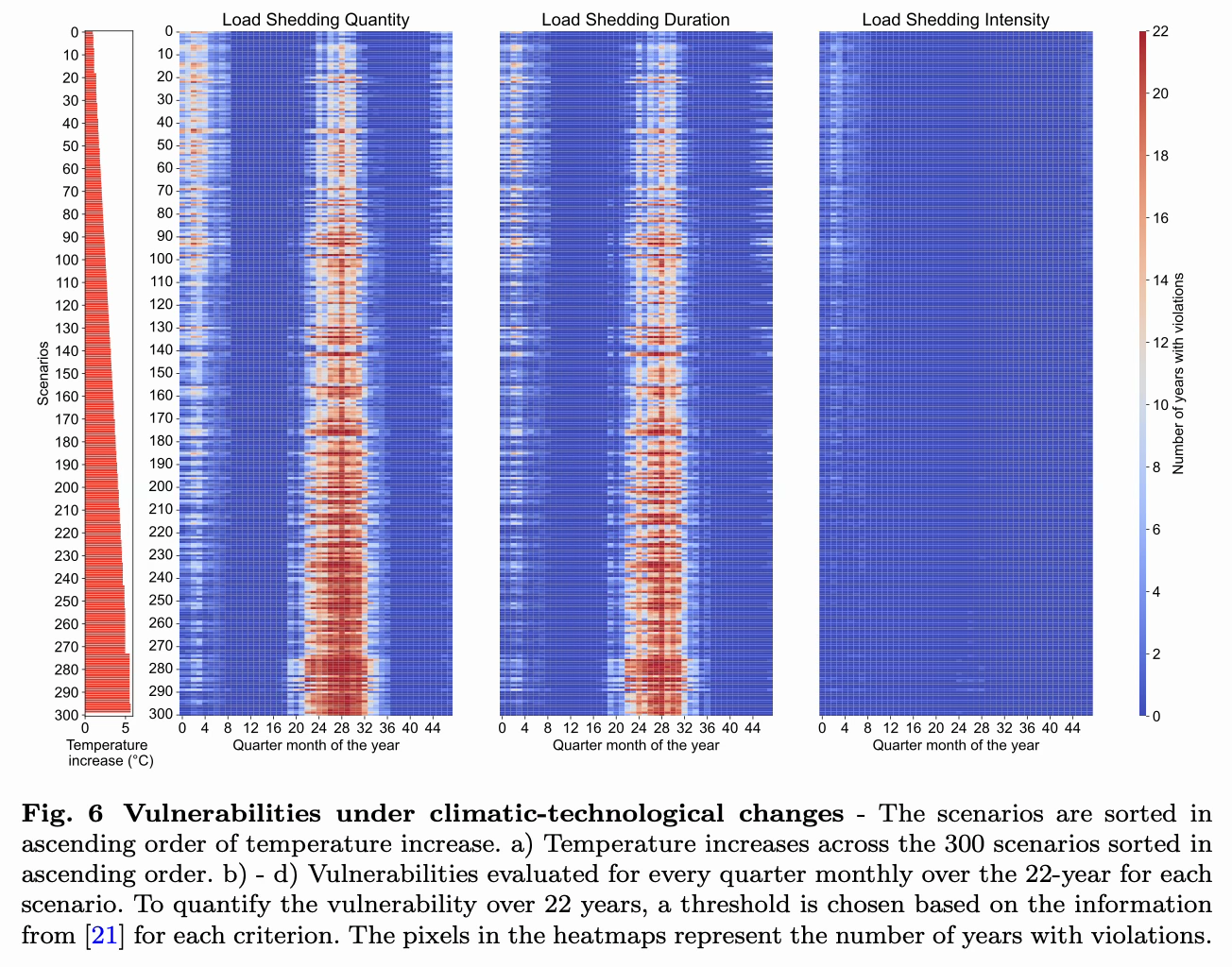
Figure 2
The broader trade-offs stem from the plan’s comprehensive ambition. New York State pursues decarbonization, labor protection, public health, and equity simultaneously. This approach requires consistent balance across tensions, including those between emissions reduction and implementation costs, infrastructure expansion and local acceptance, and statewide targets and equitable distribution for disadvantaged communities. The Clean Air Act demonstrates that clear targets and strong institutional design can produce substantial results. The challenge for the Scoping Plan is to match that implementation capacity while also managing economic and social transition tasks. The New York Scoping Plan is more ambitious than the Clean Air Act in its social and distributive goals. Its success depends on whether the state can translate those goals into a coordinated, binding, and durable delivery system.17
Conclusion
The Clean Air Act laid the groundwork for the reduction of air pollution and the establishment of the public health model. The Scoping Plan extends that foundation by expanding what climate policy is expected to achieve. Environmental policy must now answer not only whether pollution has declined but also who bears the costs, who captures the benefits, what pathways exist for displaced workers, and whether minority communities are genuinely protected. Future climate policy must prioritize implementation over planning, translating ambitious justice goals into actionable change. The evolution from the Clean Air Act to the Scoping Plan reflects a broader shift in public expectations: residents demand not only cleaner air but an equitable framework in which the socioeconomic benefits of transition are accessible to all.
Works Cited
- Environmental Protection Agency. 2016. “Timeline of Major Accomplishments in Transportation, Air Pollution, and Climate Change.” https://www.epa.gov/transportation-air-pollution-and-climate-change/timeline-major-accomplishments-transportation-air.
- Environmental Protection Agency. 2018. “Clean Air Act Requirements and History.”
- https://www.epa.gov/clean-air-act-overview/clean-air-act-requirements-and-history.
- Environmental Protection Agency. 2024. “Summary of the Clean Air Act.” https://www.epa.gov/laws-regulations/summary-clean-air-act.
- Lattanzio, Richard. 2022. “Clean Air Act: A Summary of the Act and Its Major Requirements.” Congressional Research Service. https://crsreports.congress.gov/product/pdf/RL/RL30853.
- Environmental Protection Agency. 2015. “The Clean Air Act – Highlights of the 1990 Amendments.” https://www.epa.gov/clean-air-act-overview/clean-air-act-highlights-1990-amendments.
- Juhasz, Antonia. 2024. “We’re Dying Here.” Human Rights Watch.
- https://www.hrw.org/report/2024/01/25/were-dying-here/fight-life-louisiana-fossil-fuel-sacrifice-zone.
- Rosen, Aliza, and Morgan Coulson. 2025. “The Shocking Hazards of Louisiana’s Cancer Alley.” Johns Hopkins Bloomberg School of Public Health. https://publichealth.jhu.edu/2025/the-shocking-hazards-of-louisianas-cancer-alley.
- Castellón, Idna. 2021. “Cancer Alley and the Fight Against Environmental Racism.” Villanova University Charles Widger School of Law. https://digitalcommons.law.villanova.edu/elj/vol32/iss1/2.
- New York State. n.d. “New York’s Climate Leadership & Community Protection Act.”
- https://climate.ny.gov/resources/scoping-plan.
- New York State Department of Environmental Conservation. n.d. “New York’s Response to Climate Change.” https://dec.ny.gov/environmental-protection/climate-change/new-york-response.
- New York State Climate Action Council. 2022. “New York State Climate Action Council Scoping Plan.”
- https://climate.ny.gov/-/media/Project/Climate/Files/NYS-Climate-Action-Council-Final-Scoping-Plan-2022.pdf.
- New York State Energy Research and Development Authority. 2026. “Clean Energy Workforce Commitment Expanded with $50 Million in New Funding to Prepare Workers for Careers in Energy Efficiency and Renewable Energy.” https://www.nyserda.ny.gov/About/Newsroom/2026-Announcements/2026-04-02-Governor-Hochul-Expands-Clean-Energy-Workforce-Commitment-With-50-Million-New-Funding.
- New York State Climate Act. n.d. “Why Is Climate Justice Important?” https://climate.ny.gov/resources/toolkit/-/media/project/climate/files/ClimateAct_Factsheets_Climate_R5.pdf.
- New York State Energy Research and Development Authority. 2025. “Statewide Solar for All.” https://www.nyserda.ny.gov/All-Programs/NY-Sun/Community-Solar/Statewide-Solar-for-All.
- Lim, Junghyun, Michaël Aklin, and Morgan Frank. 2023. “Location Is a Major Barrier for Transferring US Fossil Fuel Employment to Green Jobs.” Nature Communications 14 (1): 5711.
- https://doi.org/10.1038/s41467-023-41133-9.
- Hanson, Gordon. 2023. “Local Labor Market Impacts of the Energy Transition: Prospects and Policies.” National Bureau of Economic Research.
- https://www.nber.org/papers/w30871.
- Liu, Vivienne, Vivek Srikrishnan, Kenji Doering, Elnaz Kabir, Scott Steinschneider, and Anderson Lindsay. 2023. “Heterogeneous Vulnerability of Zero-Carbon Power Grids Under Climate-Technological Changes.” https://arxiv.org/abs/2307.15079.
Author Bio
Xinyi Liang is a second-year MPA student from Brooks School at Cornell. She is concentrating on labor issues in developing countries and the sustainable supply chains. Her interests also focus on environmental justice and impact investments. She holds a bachelor’s degree in fine arts from Pratt Institute, which brings her more innovative ideas to policy understanding and social activism. All interdisciplinary work experience and professional training at Brooks have shaped both her analytical and interpersonal skills. She is guided by a life mission: bringing more options to more people.