
By: Christian Bolden
Edited by: Rose Kores
Introduction: The Great Computational Paradox
The modern global economy is engaged in one of the most capital-intensive infrastructure buildouts in human history. Hundreds of billions of dollars are flooding into hyperscale data centers, high-voltage transmission lines, advanced semiconductor fabrication facilities, and localized industrial cooling networks. Driven by the generative artificial intelligence (AI) expansion, these investments are accelerating a monumental restructuring of global capital, pushing power grids to their limits and driving an estimated $1.4 trillion in necessary grid investments.1 This physical scaffolding is marketed as the foundation of a frictionless “AI Economy.”
Yet, beneath this triumphalist rhetoric lies a systemic structural defect: the hyperscale AI economy has no operating system (OS). The United States is regulating AI as software while deploying it as infrastructure without a salient, coherent strategy to achieve its ambition. That mismatch has resulted in a governance crisis. While the emergence of technology stands as the defining innovation of our time, our institutions have not yet adapted to effectively direct, manage, and deploy its power.
The OS is an essential layer in computer architecture. It controls hardware resources, mediates competing demands, enforces security protocols, and creates a stable abstraction layer for user applications. Even the most sophisticated graphics processing unit cluster is nothing more than a chaotic collection of silicon parts that will immediately, catastrophically crash without an operating system. Metaphorically and structurally, today’s AI infrastructure boom lacks the institutional operating layer. We are attempting to run a civilization-altering, resource-ravenous, technological revolution on an archaic, balkanized, and uncoordinated administrative apparatus.
|
Era |
The Operating System |
|
Industrial Revolution |
Property Rights, Commercial Banking, Rail Law |
|
Electrical Revolution |
Public Utility Commissions, FERC Predecessors |
|
The Internet Age |
TCP/IP, ICANN, DNS, SEC Digital Markets |
|
The AI Economy |
VACUUM (No Coordinated Deployment Logic) |
Change often happens slowly and we tend to experience progress at an even slower pace. In that sense, our institutions reflect the nature of democracy itself. The architecture of democracy undergoes a tectonic evolution moving with an incremental, almost undetectable gravity that sacrifices immediate responsiveness to ensure any structural shift can bear the weight of an entire society. When innovation, capital, and shared values align, a powerful paradigm shift occurs: institutions are compelled to evolve, becoming structurally optimized to catalyze, rather than constrain, mass innovation. Every major economic transformation in history has required a corresponding institutional operating system to survive:
- The Industrial Revolution: The transition from agrarian to mechanized industrial economies in the 19th century was largely restricted by local, fragmented legal systems designed for small-scale commerce. Society had to create a whole new institutional infrastructure to tap the full potential of steam power and mass production. This took the form of modern corporate law; the idea of limited liability and joint-stock ownership enabled private enterprises to pool together unprecedented amounts of capital without making the individual investors personally liable to ruin. Meanwhile, the chaotic expansion of railroads demanded the codification of formalized property rights, eminent domain structures, and standardized rail regulations, with milestones such as the Interstate Commerce Act. Without these administrative mechanisms enabling tracks, safety metrics, and shipping rates to flow seamlessly across state lines, the physical machinery of the Industrial Revolution would have been trapped in isolated, regional inefficiencies.
- The Electrical Revolution: The commercialization of electricity first emerged in the late 19th and early 20th centuries as a hyper-fragmented Wild West of localized currents, competing frequencies, and overlapping urban grids. Early adopters faced a dangerous, inefficient patchwork of alternating current and direct current systems, with frequent blackouts and no way to scale. The breakthrough that turned these volatile, localized currents into a stable, continental machine was not the electrical transformer, but a conscious political and economic compromise: the creation of Public Utility Commissions and state-sanctioned monopolies. Governments realized that repeatedly building the same power lines was a textbook case of “natural monopoly” inefficiency. As a result, they provided private energy companies an exclusive area to operate in along with strict regulations on price and infrastructure decisions. This regulatory operating system produced a public-private framework that socialized the capital costs of power generation, stabilized the grid, and eventually transformed electricity from an erratic luxury into a universal, standardized utility.
- The Internet: The digital revolution of the late 20th century pushed the boundaries of governance by offering infrastructure that was intrinsically borderless, global, and decentralized. Traditional top-down state regulation was fundamentally ill-suited to a fast-moving software-driven landscape. Rather, the operating system of the Internet was based on a very particular model of multi-stakeholder, non-governmental coordination. The core TCP/IP protocols were created by technical standards organizations such as the Internet Engineering Task Force (IETF), so the data packets could be deciphered worldwide. The founding of the Internet Corporation for Assigned Names and Numbers (ICANN) and the Domain Name System (DNS) created a decentralized but globally synchronized record for digital identities and routing. As the network evolved into a commercial engine, the traditional financial architecture had to evolve; the Securities and Exchange Commission (SEC) and global financial regulators drafted new frameworks for digital markets, electronic trading platforms, and data privacy protection. This invisible layer of global technical and financial protocols enabled private capital and decentralized innovation to flourish in a universally understood framework of digital trust.
In stark contrast, the AI economy possesses no such architecture. The core bottleneck of the AI expansion is no longer a software challenge; it is a governance coordination challenge. AI is no longer constrained by intelligence; it is constrained by institutional capacity.
I: The Six Functions of an Infrastructure Operating System
To understand the depth of the current crisis, we must look beyond policy terminology. The infrastructure stack should be evaluated through a systems architecture lens. An operating system is not a passive set of guidelines. OS is an active, real-time resource arbiter. In traditional computing, an OS performs six foundational functions. When we map these functions onto the physical and administrative demands of the AI deployment architecture, the total vacuum of our current framework exposes severe systemic misalignment.
The Computational Metaphor as an Analytical Tool
|
Computational OS Function |
Infrastructure Equivalent |
|
1. Scheduling |
Permitting & Interconnection Queues |
|
2. Memory Allocation |
Grid & Baseload Capacity |
|
3. Interrupt Handling |
Public Opposition & Litigation |
|
4. Security |
Supply Chain & Hardware Integrity |
|
5. Device Management |
Local Municipalities & Zoning |
|
6. Resource Allocation |
Electricity & Water Markets |
- Scheduling: Permitting and Interconnection Queues
In a computer, scheduling determines which software tasks get access to the processor and for how long, ensuring that critical operations are not starved by low-priority background noise. In the hyperscale AI infrastructure boom, “scheduling” has devolved into an archaic, chronological waiting room. Regional interconnection queues are severely congested, with clean energy and storage projects facing multi-year backlogs before they are allowed to connect to transmission lines.2 These grid-connection timelines have emerged as the primary bottleneck delaying critical infrastructure builds nationwide.3 Regrettably, there is no widely accepted institutional scheduler to prioritize projects that serve vital national interests over speculative real estate.
- Memory Allocation: Grid and Baseload Capacity
An OS allocates physical RAM to applications, preventing them from overwriting each other’s data or crashing the motherboard by demanding more than the system can give. Today, the AI economy treats the continental electrical grid as infinite memory. Data center electricity demand could more than double in the coming years, creating unprecedented load stresses.4 Hyperscalers are locking down vast blocks of constant power, leaving limited centralized coordination to ensure the physical grid does not suffer structural destabilization or localized temporary outages.
- Interrupt Handling: Public Opposition and Litigation
When a hardware device requires immediate attention, the OS executes an “interrupt handler” to safely pause lower-priority tasks and fix the problem. In our current deployment architecture, interrupts take the form of lawsuits, grassroots environmental resistance, and administrative challenges. An intensifying nationwide backlash against data center development is putting the broader AI boom at severe risk.5 Because there is no structured mechanism to address community and resource concerns proactively, these interrupts act as hard system crashes, indefinitely stalling multi-billion-dollar infrastructure developments. Industry stakeholders have largely failed to address this phenomenon, defaulting to defensive posture rather than proactive alignment. Communities are not a compliance obligation or a balance sheet byline; rather, they are, and must be considered, a core investment.
- Security: Supply Chain and Hardware Integrity
A secure OS enforces strict isolation of identified anomalies, ensuring that untrusted applications cannot access core system memory. In the hyperscale AI infrastructure stack, we lack basic hardware-level verification standards, leaving the global hardware pipeline highly concentrated and fragile. Concurrently, global semiconductor supply chains face profound geopolitical bottlenecks, exposing the physical foundations of our intelligence economy to hardware-level tampering, counterfeiting, and firmware exploits, all while key federal data center security oversight mechanisms are allowed to expire.
- Device Management: Municipalities and Zoning
An OS uses standardized software drivers to communicate smoothly with vastly different pieces of physical hardware. Our current system lacks this translation layer entirely. Tech conglomerates deploying global AI models must interact directly with the “raw hardware” of thousands of highly fragmented local zoning boards. History has produced an extraordinary irony: the institutions deciding the future of artificial intelligence are often the same institutions that approve gas stations, storage sheds, and housing developments.
- Resource Allocation: Electricity and Water Markets
Finally, an OS manages the distribution of basic inputs like power and cooling to keep the machine balanced. The AI economy relies on an uncoordinated market mechanism where private capital simply outbids public utilities for critical inputs like electricity and water, leaving regional ecosystems and everyday consumers to absorb the negative externalities. This has turned resources into zero-sum flashpoints.6 Across the United States, tech giants are entering hyper-dense competitive standoffs over localized electricity grids and water tables, treating shared ecological capital as standard corporate inputs.
II: The Institutional Economics of the Compute Boom
To evaluate the structural inefficiencies of this unmanaged buildout, we must utilize the basic vocabulary of institutional economics. The crisis of hyperscale AI infrastructure is a classic demonstration of coordination failure amplified by severe path dependence; a dynamic where early, uncoordinated decisions lock us into flawed long-term systems.
When a tech company attempts to build a major data center campus, it operates within a framework of fragmented transaction costs. The developer must negotiate independently with landowners, regional utility monopolies, state environmental regulators, and county executives. Because these entities do not share a synchronized operating logic, the real-world friction and costs of assembling these necessary physical components become prohibitive.
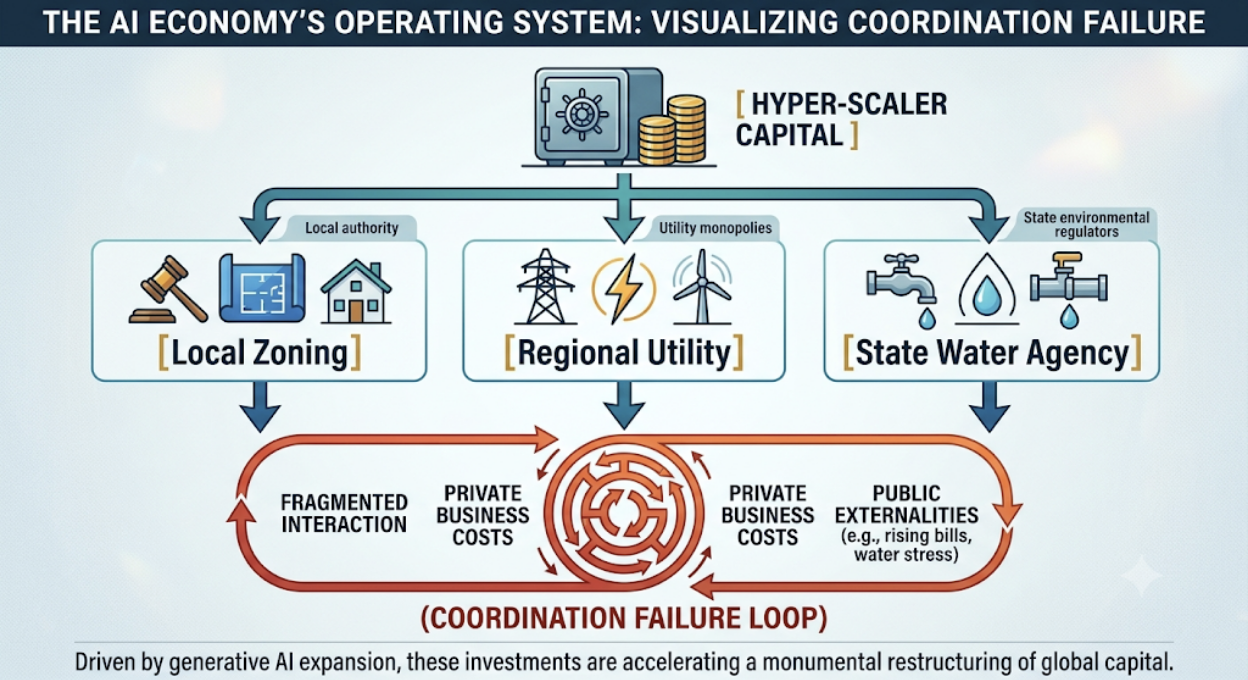
This structural fragmentation triggers an acute collective action problem. It is in the interest of the technology sector, energy sector, and the public to build an optimized, secure, and clean infrastructure stack. However, in the absence of an institutional operating layer, individual firms are driven by market pressure to engage in resource hoarding. They secure exclusive power purchase agreements, monopolize local water tables, and bypass broader grid stability considerations to lock down short-term compute capacity before their competitors do.
This dynamic creates a profound externality crisis where the costs of private business are unloaded onto the public. For instance, the surge in data center power demand is directly linked to rising electricity bills for everyday consumers.7,8 By treating these vital resources as unpriced or underpriced public goods, the current deployment model creates immediate wealth for specific tech giants while shifting the true financial and material costs, ranging from grid congestion surcharges to depleted agricultural aquifers, directly onto ordinary citizens.
III: Defining Institutional Latency
Discussions surrounding the mismatch between technological innovation and institutional oversight typically lack analytical rigor. To provide executives and policymakers with an actionable framework, this paper formalizes that friction into a quantifiable tension. We define this drag as institutional latency.
Technological capability, specifically measured by chip density, algorithmic efficiency, and capital allocation toward data center development, grows at an exponential rate. Tech giants are aggressively driving the hardware buildout to record levels, with demand for specialized AI memory chips and high-bandwidth components skyrocketing.9 Conversely, the administrative capacity of public institutions to evaluate, permit, and integrate these systems expands at a strictly linear, bureaucratic pace. The widening divergence between these two curves represents institutional latency.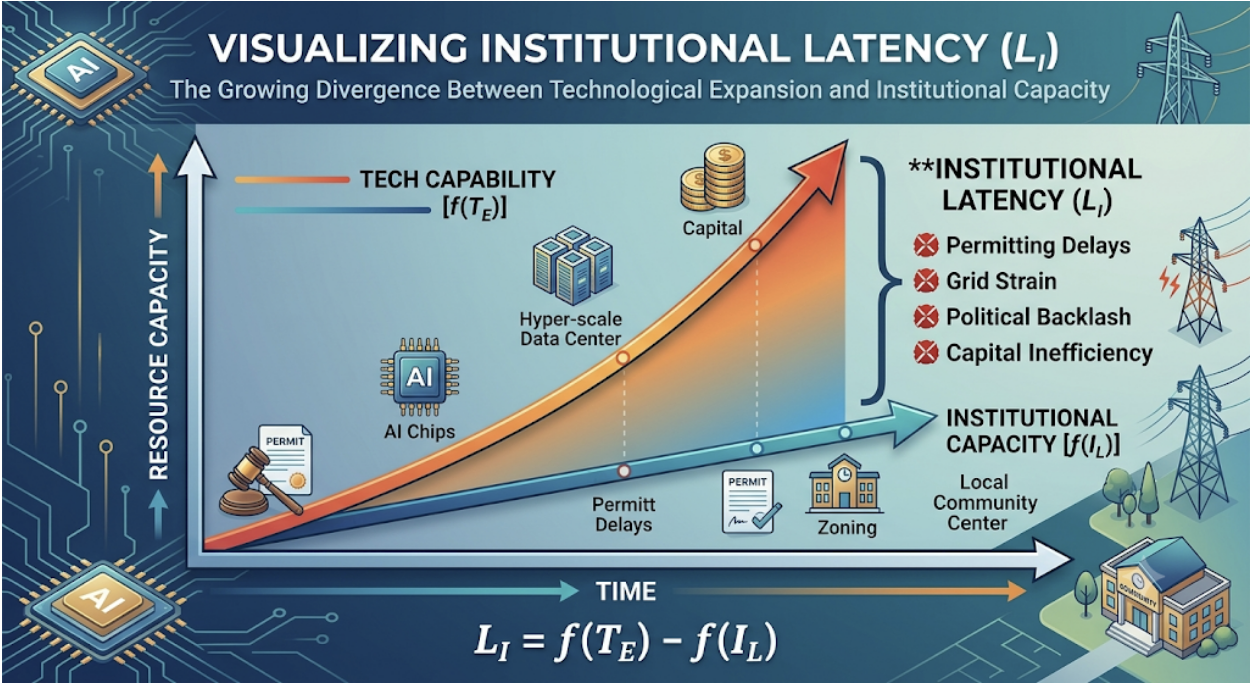
Institutional latency is the underlying cause of the friction points presently disrupting the technology sector: multi-year delays for transmission line approvals, protracted environmental litigation, infrastructure-related political backlash, and profound capital inefficiency.
When a technology firm attempts to rapidly deploy capital into a physical reality governed by linear administrative systems, it encounters an unyielding wall of institutional resistance. Escalating grid congestion and severe load growth are placing unprecedented stress on traditional systems, proving that the administrative framework is choked by its own inability to process scalable change.10
IV: Deployment Risk: The New Frontier of Infrastructure Finance
For decades, institutional investors and technology executives have evaluated projects through a well-established matrix of standard risk classes:
- Market Risk→ will customers buy it?
- Credit Risk→ can counterparties pay for it?
- Technology Risk→ will the machine work?
- Political Risk→ will regulations change?
The hyperscale AI infrastructure boom has rendered this traditional taxonomy incomplete. The broader economic ripples of AI deployment depend entirely on overcoming near-term physical resource constraints.4 The compute market is vast, the capital backing it is unprecedented, and the technology is proven. Yet, projects are stalling across developed nations. This indicates the arrival of an entirely new vulnerability vector in infrastructure finance: deployment risk, which is the probability that capital cannot be converted into functional physical infrastructure because the surrounding institutional systems cannot synchronize with the rate of technological change.
The Modern Risk Matrix
|
Risk Class |
Core Vulnerability |
|
Market Risk |
Will demand support the asset price? |
|
Credit Risk |
Can the counterparty honor financial obligations? |
|
Political Risk |
Will sovereign legislative changes disrupt returns? |
|
Cyber Risk |
Can digital assets be breached or expropriated? |
|
Deployment Risk |
Will institutional friction prevent capital from becoming functional physical infrastructure? |
Deployment risk explains why a technology giant can possess tens of billions in cash and an optimized model design but is unable to secure the basic electricity required to turn those servers on. It is the financial realization of institutional latency. Until organizations learn to calculate, price, and mitigate deployment risk, they will continue to experience severe capital misallocation, overestimating the speed at which their digital capabilities can manifest in physical space.
V: The Geography of Discontent: The Democratic Deficit
The lack of a coherent institutional operating layer has transformed the physical deployment of AI into a process of geographic extraction. With no overarching coordination logic to balance corporate expansion with regional sustainability, data centers are increasingly viewed by local populations as modern industrial enclaves that take far more than they give.
This extraction-to-benefit asymmetry is creating an intense public backlash that has rapidly entered mainstream electoral politics. Local and state elections are increasingly hinging on voter anger over data center footprints.11 In rural and suburban communities, grassroots coalitions are organizing to challenge, delay, and block developments, driving a structural resistance movement against an economy that treats local communities as mere resource colonies for digital networks.7 Their grievances are deeply rooted in material reality:
- Water Table Depletion: The highest-using individual building in its Virginia dataset consumed about 243 million gallons; most facilities used dramatically less.12 This astronomical consumption has forced environmental flashpoints: drought-ravaged states have formally requested data centers to drastically curtail water use, while tighter regulatory gridlock surfaces as data centers collide with universal water restrictions during structural droughts.13
- Grid Premium Costs: Municipal populations are witnessing their baseline utility costs climb to fund the massive transmission line and substation upgrades required to feed nearby data center campuses.
- Socioeconomic and Legislative Fractures: Major legislative gridlocks show that lawmakers are walking an increasingly treacherous tightrope, caught between tech sector pressure and local resistance over state resources and tax incentives.
This dynamic exposes a profound democratic deficit. When the deployment of critical technology is perceived to degrade the daily lives of citizens without yielding clear, reciprocal local utility, the state forfeits its foundational infrastructure legitimacy. Ultimately, no technological revolution can sustain its momentum in the absence of a robust social license.
VI: The Doctrine of Responsible Growth
To resolve the crisis of institutional latency and mitigate systemic deployment risk, we must move past the false choice between uncoordinated corporate expansion and rigid regulatory stagnation. We require an entirely new operational framework: the governance doctrine of responsible growth.
Responsible growth is neither a static compliance checklist nor an insulated corporate social responsibility initiative; it is an active institutional synchronization framework. By shifting the unit of analysis from software safety to infrastructure integration, this paradigm recognizes that the long-term viability of the AI economy is fundamentally contingent upon the health, resilience, and stability of its supporting physical and social systems.
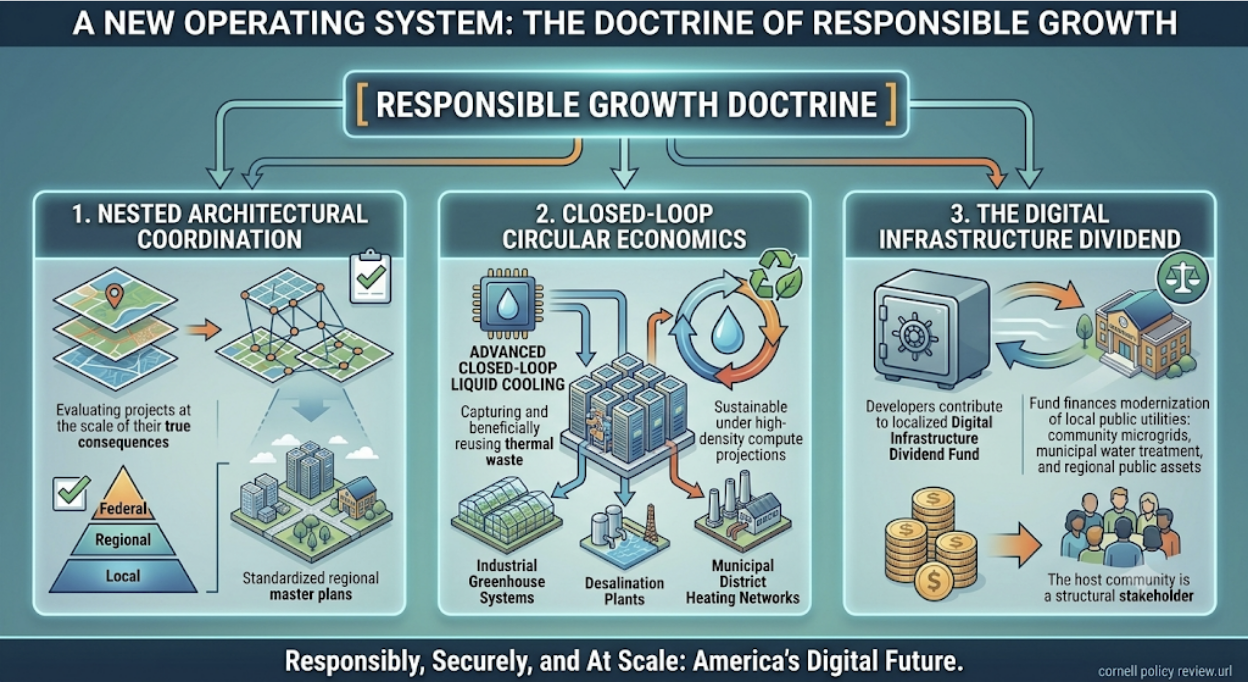
The realization of this doctrine requires an institutional operating system structured around three pillars:
- Nested Architectural Coordination
Rather than implementing heavy-handed federal takeovers or leaving decisions to isolated municipalities, the institutional operating system must create a nested hierarchy of authority. Local authority should not be eliminated; it should be embedded within regional and national coordination frameworks capable of evaluating projects at the scale of their actual consequences. Local governments can drastically improve data center development, provided they are integrated into broader, standardized regional master plans.14 State and corporate leaders must tread carefully to craft energy and infrastructure bills that balance developer velocity with systemic public utility protection.
- Closed-Loop Circular Economics
The institutional operating layer must phase out the uncoordinated consumption of natural resources. Traditional open-loop evaporative cooling, where water is simply boiled off into the atmosphere to cool chips, is fundamentally unsustainable under current load projections. Responsible growth mandates that future high-density compute infrastructure utilize advanced closed-loop liquid cooling architectures that recycle their water. Furthermore, data center facilities must be structurally integrated into local circular resource chains. These complexes should be co-locating clusters directly with industrial greenhouse systems, desalination plants, or municipal district heating networks to capture and beneficially reuse the massive volumes of thermal waste generated by hot silicon.
- The Digital Infrastructure Dividend
To eliminate the democratic deficit, the relationship between capital tech hubs and host communities must be structurally rebalanced. Under instructional blueprints from leading institutions, developers should contribute directly to a localized digital infrastructure dividend fund. Rather than offering volatile tax revenues prone to corporate depreciation loops, this fund must directly finance the modernization of local public utilities installing community microgrids, expanding municipal water treatment infrastructure, and funding regional public assets. The host community must become a structural stakeholder in the compute economy, transforming local resistance into shared equity.
VII. The Strategic Cost: Compute Sovereignty, National Competitiveness, and Grid Colonialism
The consequences of institutional latency and unchecked deployment risk extend far beyond inefficient capital allocation; they threaten the foundational macroeconomic positioning, technological sovereignty, and social stability of the nation. In a global landscape where computational supremacy is directly correlated with geopolitical influence, the inability to rapidly transition liquid capital into physical infrastructure creates an acute national vulnerability. For decades, leadership in the digital economy was determined purely by software breakthroughs and silicon design. In the exascale AI era, however, the playing field has shifted to the physical landscape. If a nation possesses premier algorithmic architects but cannot provision high-voltage transmission lines or baseload power, the technological value chain fractures, handing an asymmetric operational advantage to centralized, authoritarian competitor nations capable of mandating infrastructure synchronization at speed.
- Capital Flight and Supply Chain Vulnerabilities
This domestic administrative drag directly triggers capital flight and aggressive infrastructure arbitrage. Because capital is fluid and hyperscalers require immediate compute capacity to survive, multi-year regional interconnection delays compel institutional investors to seek international markets that offer expedited, predictable pathways to energy and regulatory scheduling. This flight offshores more than digital real estate; it permanently migrates the downstream ecosystem of advanced engineering, data security infrastructure, and localized economic multipliers. Concurrently, as domestic deployment stalls, existing networks become increasingly reliant on highly concentrated, fragile global supply chains for core hardware components like high-voltage step-up transformers and specialized cooling infrastructure. This uncoordinated reliance converts a bureaucratic administrative delay into a profound national security vulnerability, yielding structural leverage to external supply chain bottlenecks.
- Grid Colonialism and Public Resource Displacement
Domestically, this institutional operating vacuum shifts the structural weight of the compute boom directly onto host communities and citizens through a dynamic of “grid colonialism.” Private technology enterprises utilize vast purchasing power to secure exclusive power purchase agreements, systematically monopolizing localized clean-energy generation. This effectively starves local municipalities of the green energy assets required to meet public climate mandates, forcing ordinary citizens to rely on aging, fossil-fuel baseload power longer than intended. Simultaneously, municipalities are left to bear the brunt of rising utility costs to fund defensive grid transmission upgrades.
This extraction extends deeply into the shared ecological and agricultural capital of the populace, turning basic resources into zero-sum flashpoints. In rural and suburban deployment corridors, high-density data centers place an unsustainable draw on localized water tables for evaporative cooling, with single campuses consuming upward of 2 billion gallons of water annually. When these massive corporate requirements collide with cyclical regional droughts, agricultural operations and residential wells are forced into strict water restrictions to preserve data center continuity. Rather than acting as pillars of a frictionless digital economy, these facilities increasingly function as modern industrial enclaves that degrade local quality of life via the low-frequency acoustic noise from continuous HVAC chiller arrays and air quality risks from diesel backup generator testing cycles.
- The Stranded Asset Liability and Democratic Deficit
Ultimately, a failure to synchronize this buildout creates a massive, stranded asset liability for local governments and compromises the democratic process. If hyperscalers over-commit capital to regions that cannot deliver long-term baseload capacity due to worsening grid congestion, communities run the risk of being left with massive, under-utilized concrete shells that hollow out traditional tax bases. Instead of fostering diversified technology corridors, the populace is left holding the structural, aesthetic, and financial baggage of uncoordinated growth. Without an institutional operating system to ensure equitable, circular resource integration, the physical deployment of AI loses its foundational infrastructure legitimacy, transforming localized public resistance into a permanent, unyielding barrier to national technological progress.
Conclusion: The Real AI Challenge
The defining challenge of the AI economy is no longer whether machines can think. The challenge is whether democratic institutions can coordinate intelligence at the scale of the 21st century. History rarely remembers the societies that merely invent transformative technologies; it remembers those that construct the institutional architectures capable of successfully deploying them. The invention of the steam engine mattered only when society created modern corporate law and rail regulation to lay track across continents. The mastery of electricity achieved its potential only when public utility frameworks stabilized the grid and extended power to every home.
America has engineered the world’s most sophisticated intelligence. It has not yet built the institutional operating system capable of deploying it responsibly, securely, and at scale. The question is not whether America can build enough data centers. It is whether it can build the institutional architecture required to make those data centers politically durable, economically efficient, and democratically legitimate. Until it does, the ultimate limitation on the AI economy will not be the supply of semiconductors, the parameters of models, or the cleverness of algorithms. It will be the capacity of our institutions to coordinate, secure, and validate the physical foundations of progress.
Works Cited
- Yahoo Finance. 2026. “Smart Grid Market Dynamics, Opportunity Analysis and Forecasts 2026-2035 with Siemens, Schneider Electric, General Electric, ABB, Itron, and IBM Leading.” https://finance.yahoo.com/sectors/energy/articles/smart-grid-market-dynamics-opportunity-100500265.html.
- Rand, Joseph, Anna Cheyette, Chris Talley, et al. 2026. “Queued Up: Characteristics of Power Plants Seeking Transmission Interconnection.” Lawrence Berkeley National Laboratory (LBNL). https://emp.lbl.gov/queues.
- Federal Energy Regulatory Commission (FERC). 2025. “FERC Directs Nation’s Largest Grid Operator to Create New Rules to Embrace Innovation and Protect Consumers.” https://www.ferc.gov/news-events/news/fact-sheet-ferc-directs-nations-largest-grid-operator-create-new-rules-embrace.
- S&P Global. 2026. “The AI Revolution’s Power Problem: Data Center Growth Meets Grid Reality.” https://www.spglobal.com/commodityinsights/en.
- DePillis, Lydia. 2026. “Local Opposition Is Slowing A.I. Data Centers. Wall Street Has Noticed.” The New York Times. https://www.nytimes.com/2026/03/26/business/economy/ai-data-centers-construction-local-opposition.html.
- United Nations News. 2025. “AI’s Environmental Costs Threaten Water, Land and Climate.” https://news.un.org/en/story/2026/06/1167658.
- Howland, Ethan. 2026. “PJM Capacity Hit Price Cap, Reserve Shortfall Grows.” Utility Dive. https://www.utilitydive.com/news/pjm-capacity-auction-price-cap-reserve-shortfall/825282/.
- Blunt, Katherine. 2025. “Who Pays? AI Boom Sparks Fight Over Soaring Power Costs.” The Wall Street Journal. https://www.wsj.com/business/energy-oil/ai-data-center-power-costs-bbfcd862.
- Shugart, Laurel. 2026. “Forecasting Data Centers’ Demand.” Harvard Magazine. https://www.harvardmagazine.com/ai/data-center-siting-optimization.
- St. John, Jeff. 2026. “PJM’s Big New Data Center Plan: Make the States Figure It Out.” Ohio Capital Journal. https://ohiocapitaljournal.com/2026/08/10/pjms-big-new-data-center-plan-make-the-states-figure-it-out/.
- Allen, Catherine, and Noah Baustin. 2026. “What Most Battleground House Districts Have in Common: Data Centers.” Politico. https://www.politico.com/news/2026/06/13/battleground-house-districts-data-centers-00952073.
- Virginia Joint Legislative Audit and Review Commission (JLARC). 2024. “Data Center Impacts in Virginia.” https://jlarc.virginia.gov/landing-2024-data-centers-in-virginia.asp.
- Mims, Christopher. 2026. “AI Data Centers Use Far More Water Than Most Tech Giants Report.” Wall Street Journal. https://www.wsj.com/tech/ai/ai-data-centers-water-use-901e2902.
- National Association of Counties (NACo). 2024. “Managing Infrastructure, Land Use, and Grid Demands at the County Level.” https://www.naco.org/resources.
Author Bio

Christian Bolden is the architect of the Responsible Growth Governance Framework and Principal of The Bolden Group, a government affairs and strategic advisory firm focused on the governance of large-scale infrastructure and sustainable economic development. The firm’s work engages governments, digital infrastructure developers and operators, investors, and community leaders at the intersection of public policy, institutional capacity, capital deployment, and long-term growth. He is a Fulbright Scholar and holds a Bachelor of Arts from the University of Mobile, a Master of Business Administration from Syracuse University, and is an Executive Master of Public Administration candidate at Cornell University’s Brooks School of Public Policy.