By: Adrian Gomez and Mouda Al Zaydan
Edited By: Stephen Shiwei Wang
Introduction
Policymaking is a dynamic process involving a number of variables that affect a given policy’s likelihood of becoming enshrined in law. In fact, only seven percent of the more than 10,000 bills that Congress considers each session will be signed into law.1 This leaves policymakers, lobbyists, special interest groups, citizens, as well as any other parties interested in the passage of policy, with a great deal of uncertainty on how to ensure that the issues they care about will be addressed. The Policy Passage Probability Model (PPPM) is an original equation designed for use in the American political context and an attempt to make sense of a seemingly chaotic process by incorporating concepts from game theory, decision theory, systems thinking, and political science to quantify the viability of pending legislation.
The PPPM is a conceptual model developed to estimate the likelihood that a bill will be enacted in the U.S. Congress. It seeks to quantify the complex, multidimensional nature of legislative success by integrating both institutional and contextual factors. The model draws from a wide range of empirical political science research, including theories of legislative behavior, public opinion dynamics, and agenda-setting. Its design reflects the premise that a single factor rarely determines policy outcomes; rather, they result from the convergence of various factors.
One of the major inspirations for the PPPM was John Kingdon’s Multiple Stream Analysis (MSA) framework. The problem, policy, and politics streams are three distinct areas that incorporate a variety of stakeholders and external events to provide insight into why some bills succeed while others fail. MSA acknowledges that although developments in one or two streams may create opportunities for policymakers or interested stakeholders, it is only when all three streams align that a “policy window” opens and there is a viable chance of a bill being signed into law.2 The PPPM distills the events and stakeholders that are encompassed in the MSA framework into an equation that can be applied to any policy.
In an attempt to establish some sense of order in an otherwise chaotic process, we used game theory to identify key variables that affect the likelihood that a policy will pass Congress. Game theory examines interactions among “players” and analyzes their possible decisions to better understand which strategies would be optimal in their situation.3 Our model was originally designed to predict the final outcome of the “game”, which in this case is the policy-making process. Thus, providing an equation that political “players” can use to better understand if a policy window has opened, and perhaps even influence when that window opens.
Policy Passage Probability Model
The PPPM incorporates seven variables in the numerator, each representing a dimension of policy support or momentum, and one variable in the denominator to account for the obstructive effect of congressional polarization. The derived equation is as follows: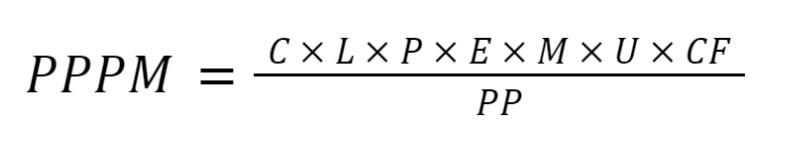
Each component of the model corresponds to a real-world phenomenon shown to influence bill passage: C for Congressional Support, L for Legislative Effectiveness, P for Public Support, E for Economic Feasibility, M for Media Salience, U for Urgency, and CF for Charisma Factor. These are offset by PP, Political Polarization, which weakens the bill’s chances of passage as ideological divides widen. This equation means that the likelihood of a policy passing depends on the product of congressional and public support, legislative effectiveness, economic feasibility, and media reports, as a portion of political divisiveness. The result is a flexible, data-informed model that aims to simulate the relative viability of proposed legislation under varying conditions.
PPPM Variables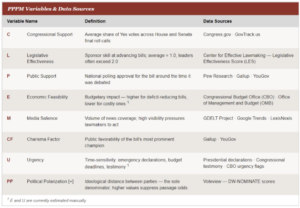
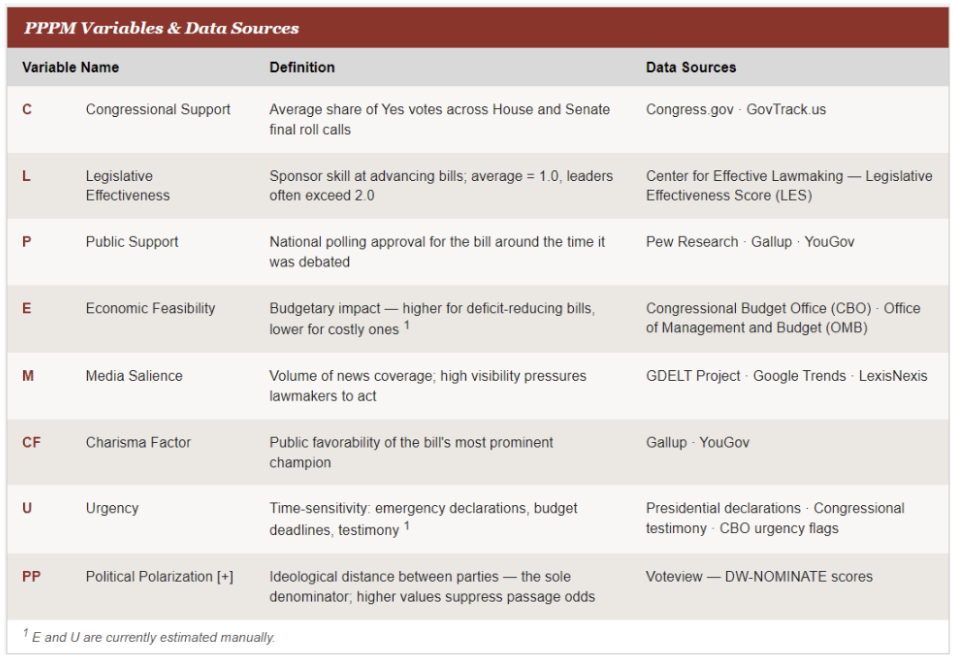
The table above details the variables in the equation and the datasets used to determine the score for each variable, although there are some distinctions in how each is measured. Legislative Effectiveness (L) captures how skilled and influential the bill’s main sponsors are when it comes to navigating the legislative process. For this, we used the Legislative Effectiveness Score (LES) from the Center for Effective Lawmaking (CEL), which evaluates lawmakers based on how frequently and successfully they introduce bills, move them through committees, and secure enactment into law. Because LES is a comparative, continuous metric rather than a capped index, some highly effective legislators can score well above 2.0, particularly those in leadership positions or with a long track record of advancing complex legislation.
Political Polarization (PP) is the only variable in the denominator of the PPPM, and it represents the degree of ideological distance between the two major parties in Congress. We measured this using DW-NOMINATE scores from Voteview, which quantify how far apart Democrats and Republicans are based on roll call voting patterns.4 This variable is scaled from 0.3 to 0.9 to reflect the historical range observed in U.S. congressional data. The lowest polarization ever recorded was around 0.3 in the 1960s, during a period of relative bipartisan overlap. At the other end of the scale, 0.9 reflects the peak polarization levels that have been measured in the 2020s, where party lines are sharply divided, and cross-party cooperation is rare. We don’t allow the scale to go to zero because some degree of ideological difference is always present in our political system.
PPPM Score
Once a PPPM score is calculated for a given bill, it is interpreted using a five-tier scale that reflects the estimated likelihood of passage. These tiers are not arbitrary; they are based on preliminary testing across real-world legislation and are aligned with observable legislative behavior.
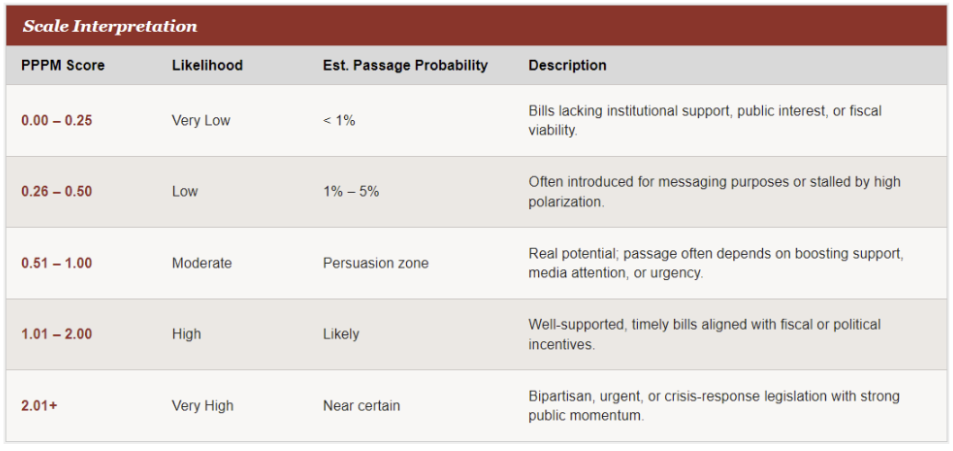
This interpretation scale helps contextualize PPPM scores in a way that’s intuitive for policymakers, advocates, and analysts. Rather than predicting a binary outcome, the model highlights how likely a bill is to succeed under current conditions. It gives a sense of where a bill stands, how close it is to passing, and where strategic intervention might make a meaningful difference.
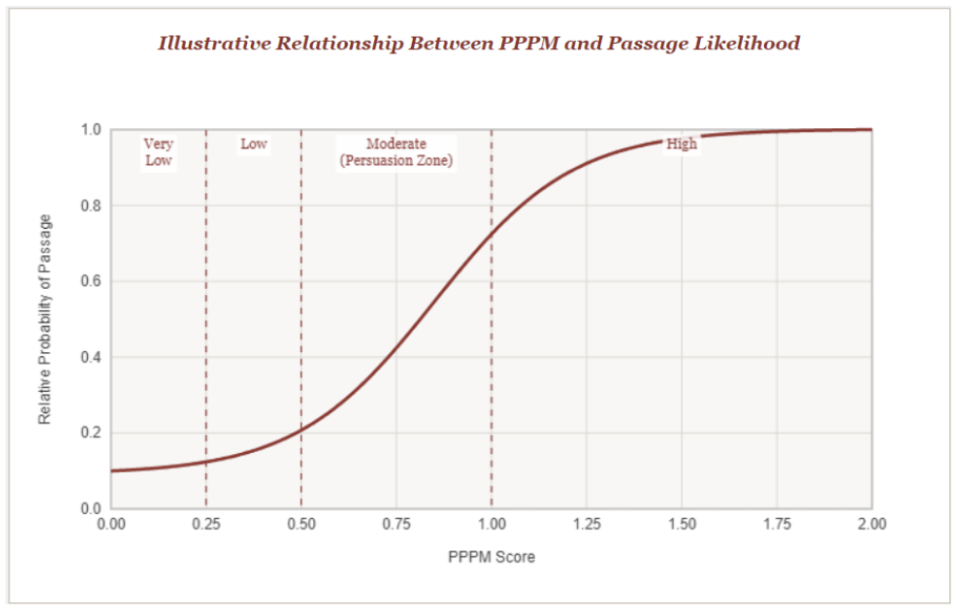
As shown in the graph above, the relationship between PPPM scores and the likelihood of legislative passage is inherently non-linear due to the model’s multiplicative structure, which is used to mimic real-world factors. For lower score ranges below 0.5, at least one critical variable remains insufficient, which suppresses the overall probability of passage. However, once the PPPM exceeds this threshold, it indicates that multiple key conditions are simultaneously aligned. At this point, the variables begin to reinforce one another, producing a rapid increase in the likelihood of passage. This dynamic reflects a threshold effect consistent with MSA’s policy window theory, in which legislative success becomes significantly more likely once specific factors converge.
PPPM in Action
In 2021, two major pieces of legislation defined the first year of the Biden presidency: the Bipartisan Infrastructure Bill and the Build Back Better Act. Both were part of President Biden’s larger domestic agenda and were debated on the House and Senate floors nearly simultaneously. Yet, their outcomes diverged dramatically. The Bipartisan Infrastructure Bill passed Congress and was signed into law on November 15, 2021, while the Build Back Better Act, despite passing the House just days later on November 19, ultimately stalled in the Senate and had to be rebranded and reformed into the Inflation Reduction Act.7
This contrast offers a compelling use case for the PPPM model. Although both bills came from the same administration, at the same time, with overlapping priorities, they received very different scores and final results.
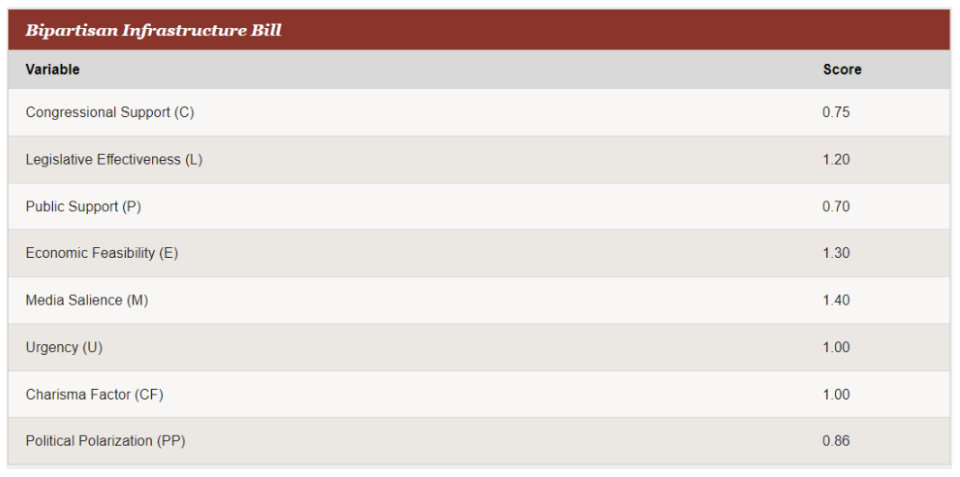
The Bipartisan Infrastructure Bill scored consistently high across most variables. It was developed with cross-party negotiations in the Senate, helping to raise its Congressional Support score, and its economic feasibility was bolstered by support from business groups and the CBO. The media covered it extensively, particularly the bipartisan breakthrough it represented, while urgency was high due to deteriorating infrastructure nationwide. The PPPM score of 1.33 placed it firmly in the high likelihood category, and the bill’s ultimate success in Congress reflects that prediction.
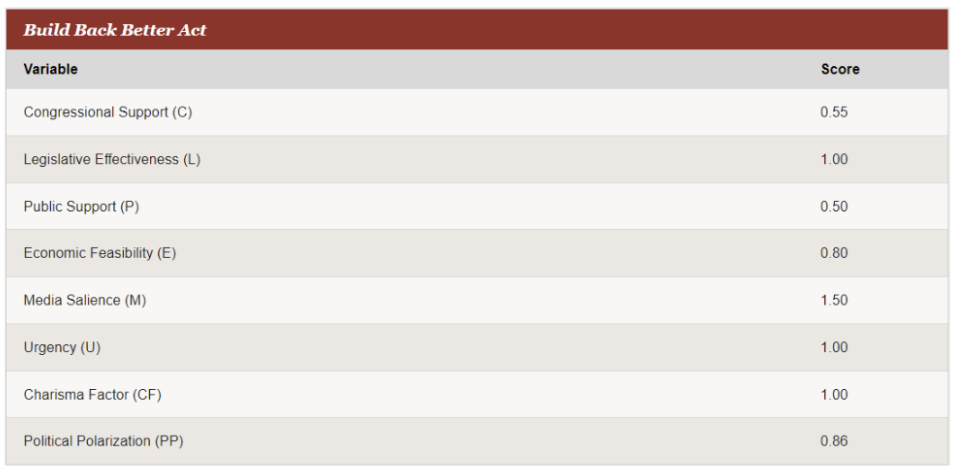
The Build Back Better Act had strong urgency and media salience; it dominated headlines for weeks and was a central pillar of the administration’s domestic policy. However, it scored much lower in Congressional and public support. Although it passed the House, its slim margin and lack of Senate consensus, particularly from key moderates, held it back. Public opinion was also more divided, and the bill’s broader scope and higher price tag weakened its economic feasibility score. With a final PPPM score of 0.38, the model placed it in the low likelihood range, accurately forecasting its failure in the Senate despite the momentum it initially had.
These two bills demonstrate how the PPPM can help distinguish between policies that appear similar on the surface but have very different political realities beneath the surface. The contrast also reinforces the idea that media attention and urgency alone are not enough; passage requires alignment across multiple dimensions, including institutional support, budget compatibility, and public opinion.
Impact of Polarization
Polarization plays a crucial role in the PPPM, and incorporating it as a key factor sets this model apart from other frameworks. The inclusion of polarization in the PPPM creates a more robust model that accounts for real-world dynamics that affect a policy’s ability to become law. In the model, polarization is the only variable that is divisible, highlighting how polarization leaves no aspect of the policymaking process untouched.
We have seen the impact of polarization in Congress as bipartisanship becomes rarer. In fact, in a Pew study which relied on the same DW-Nominate score used in the PPPM to measure polarization, it was found that political moderates are becoming an endangered species, as there has been zero overlap between the least left and right-leaning members of Congress since 2002.5,6
Under high levels of polarization, the only bills that have a chance of passing are those that are the most urgent and receive the highest media attention, requiring an “all hands on deck” mindset. This is why, since the 100th Congress (Jan. 6, 1987- Oct. 22, 1988), the amount of legislation passed, excluding those passed through incorporation, has dropped nearly every 2 years and has gone from seven percent to one percent in the 118th Congress (Jan. 3, 2023 – Jan. 3, 2025).
Next Steps
To develop the PPPM into a truly functional and accurate model for policymaking, several steps must be taken to improve its effectiveness. The most important step is to validate every variable in the model both externally and internally. Currently, the variables of Charisma, Media Influence, and Economic Impact are more difficult to measure and would require either locating existing datasets that measure these areas or developing an internal process to validate them. Congressional Support would also need a more reliable dataset since we are currently analyzing bills retroactively. More objective datasets would greatly improve the model’s accuracy, and there may also be a need to add variables or account for connections among factors. The equation also does not account for situations involving a unified government, where polarization may not be a factor.
The next step after the variables have been validated is to run regressions on each variable to determine how much influence it truly has on policymaking. This would allow us to assign each variable a numerical value between zero and one and add value multipliers, which would more accurately represent the impact of each factor and improve the model’s accuracy.
To examine the statistical significance of the result, a t-test can show that the differences are not random, and a logistic regression can assess whether higher PPPM scores actually increase the chances that a bill passes. For a model to be truly predictive, the key is to improve the variables. Although the PPPM may serve a better function as a structured decision-making tool for practitioners than as a political crystal ball. Although the idea started as a predictive model, it may be more useful as a way for stakeholders to inform their tactics and strategies. In discussions with stakeholders with backgrounds in the policymaking process, they noted that the PPPM was similar to the mental models they use when advocating for and passing a policy. In this sense, it would serve as a tool that provides a more objective view of a highly subjective process, offering greater clarity and informing the decisions of policy advocates. Therefore, a low, middle, or high PPPM score would be used to identify viable strategies and better understand when to build more support for a bill, when a coalition should be built, and when that coalition should push for a bill’s passage.
Another area to address is the use of AI alongside manual scoring when testing the PPPM across various bills. This process can create variability and introduce error and bias into the scoring. AI showed great capabilities for predictive modeling using the PPPM, but there were limitations, and manual checks were needed to ensure the scores were accurate. Although we ran a comparison of the average PPPM score of bills that passed vs those that failed, which showed high promise, this was also done using AI and would need to be validated through more rigorous testing. The use of AI to build, improve, and utilize the PPPM shows great promise if used effectively.
Following these steps, one can use the equation to make predictive statistical inferences with more precise tuning, thereby achieving greater objectivity in a highly subjective policy process. Notably, this model is used to build correlations and thus statistical projections, and it is by no means used to establish a causal relationship. The actual policy-passing mechanism is a complex system with dynamic and emergent behaviors that are unobservable in the data, if at all. Overall, we believe that this model could be used effectively to inform the strategies of those involved in the policymaking process and can support researchers in improving their understanding of the process.
Works Cited
- GovTrack.us, “Summary of H.R. 5376 (117th): Inflation Reduction Act of 2022,” 2022, https://www.govtrack.us/congress/bills/117/hr5376/summary.
- John W. Kingdon, Agendas, Alternatives, and Public Policies (Pearson Education Limited, 2003).
- M. D. Davis and S. J. Brams, “Game Theory,” Encyclopedia Britannica, March 24, 2026, https://www.britannica.com/science/game-theory.
- J. B. Lewis, K. T. Poole, H. Rosenthal, A. Boche, A. Rudkin, and L. Sonnet, “Congress View: House of Representatives,” Voteview, accessed April 12, 2026, https://voteview.com/congress/house.
- Drew DeSilver, “The Polarization in Today’s Congress Has Roots That Go Back Decades,” Pew Research Center, March 10, 2022, https://www.pewresearch.org/short-reads/2022/03/10/the-polarization-in-todays-congress-has-roots-that-go-back-decades/.
- Ibid.
- Ibid.
Author Bio 

Adrian Gomez is a second-year MPA fellow at Cornell University’s Jeb E. Brooks School of Public Policy, concentrating in Government, Politics, and Policy Studies. He earned acceptance into the certificate program for Systems Thinking, Modeling, and Leadership and the State Policy Advocacy Clinic. Prior to joining the MPA program, Adrian received a Bachelor of Arts in Interdisciplinary Studies focusing on Journalism, Cultural Anthropology, and International Security and Conflict Resolution (ISCOR). He then worked in the non-profit sector, where he supported county child welfare agencies in Southern California with capacity building, policy and resource development, and workforce development efforts to improve outcomes in marginalized communities. He has experience working directly with community members, service providers, policymakers, and practitioners to advocate for policies at the state and local level and is a founding Executive Board member and Vice President of the Cornell Negotiation Student Society.

Mouda Al Zaydan is a second-year MPA fellow at Cornell University’s Jeb E. Brooks School of Public Policy, concentration in Government, Politics, and Policy Studies. She has been part of the Cornell Policy Review managing team for two years and served as the managing editor for 2025-26. She earned her Bachelor of Arts in Visual Arts and Design from Siena University, with concentrations in Nonprofit Management and Community Development. Her academic and professional journey has fueled her passion for sustainable development, systems thinking, policy design, and organizational behavior. She was also a Graduate Researcher at the Journal of Systems Thinking (JoST), focusing on exploring the science and practice of systems thinking.