By: Florencia Malau
Edited By: Parmis Mokhtari-Dizaji
This year’s UN Climate Change Conference (COP30) in Belém concluded with mixed outcomes. Countries committed to scaling up climate finance, including a pledge to triple adaptation finance by 2035.1 However, the conference failed to deliver a coordinated implementation framework to phase out fossil fuels.2 This gap is notable as the global energy transition accelerates in ambition and complexity, requiring stronger international alignment.
As mitigation efforts expand, climate policies increasingly generate spillovers that extend beyond the countries that adopt them. These spillovers influence trade patterns, investment flows, and macroeconomic stability. Their effects are particularly pronounced in fossil fuel-reliant economies, where shifts in global demand can quickly translate into fiscal pressures.3,4 Indonesia exemplifies these vulnerabilities: its deep dependence on coal leaves it highly exposed to the spillover risks created by the accelerating transition toward renewable energy.
Understanding Climate Policy Spillovers
Climate policies rarely remain confined within national borders. When a country adopts carbon pricing or subsidizes renewable energy, the effects extend through global trade and financial systems. As climate mitigation efforts increasingly intersect with industrial policy5,6 and unilateral action becomes more common,7 understanding spillover effects is essential for designing effective mitigation strategies.
Positive and Negative Spillovers
In the climate context, spillovers occur when a country’s climate mitigation policies create consequences, intended or not, in other jurisdictions. Climate policies typically generate three positive spillovers: reduced global climate costs through emission reductions, lower transition costs through green technology dissemination, and policy diffusion as countries emulate successful measures.8 A common example is how technological advances in one country reduce research and development costs for others, enabling faster and cheaper deployment of clean technologies.
However, not all spillovers are positive. Policies that raise costs for domestic producers, such as carbon pricing, can lead firms to shift production to countries with weaker climate regulations. This phenomenon, known as carbon leakage, undermines environmental objectives and creates competitiveness concerns.9
Mehling (2024) proposes a framework that groups spillovers into two categories: measures that impose private costs on emissions (for example, carbon pricing) and measures that socialize climate mitigation costs (for example, subsidies for clean energy or public investment in R&D). Table 1 outlines how these spillovers emerge across different policy contexts:
Table 1: Types of climate-related spillover effects (Mehling, 2024)
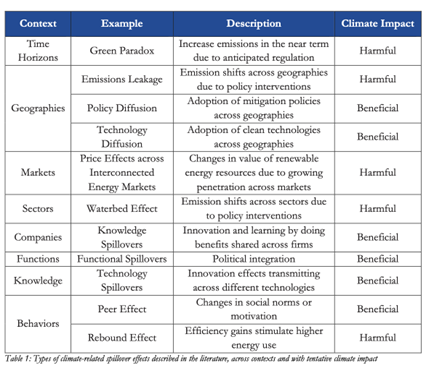
While many studies examine the effects shown in Table 1, far less attention has been given to how climate policy spillovers affect sovereign fiscal positions and financial stability.10,11 This gap is especially relevant for economies that are heavily reliant on fossil-fuels exports.
From a market perspective, climate policies aim to shift demand away from fossil fuels to low-emission goods. In a fragmented world with limited coordination across regions on climate mitigation, declining demand for fossil fuels is expected to lower the trade-to-GDP ratio and subsequently create economic shocks for fossil fuel-dependent countries.12,13
Indonesia at Critical Juncture
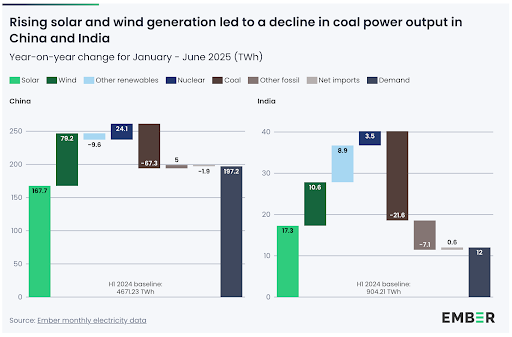
Indonesia provides a salient example of how spillovers influence financial outcomes in terms of fiscal positions. As the world’s sixth largest coal producer and Southeast Asia’s largest supplier14, Indonesia produced a record 836 million tons of coal in 2024 after three consecutive years of growth.15 However, this trend is expected to shift as export demand weakens in 2025.16 Increasing deployment of solar and wind power in China and India, Indonesia’s major trading partners, is displacing coal demand.17,18
Figure 1: Rising solar and wind generation led to declining coal power output in China and India (Setiawan, 2025)
At the same time, Indonesia submitted its updated Nationally Determined Contribution (NDC) one month before COP30, pledging to cut emissions by 31.89% (unconditional) to 43.20% (conditional) by 2030. The country aims to reach net-zero emissions by 2060, with emissions peaking at an estimated 1,244 MtCO₂e in 2030 before declining to 540 MtCO₂e by 2050.19,20
This new commitment, coupled with falling demand from major trading partners, places Indonesia at a critical juncture. Domestically, Indonesia must significantly reduce its coal use. Externally, fossil fuel exports are expected to shrink as countries such as China accelerate their low-carbon transitions. Together, these trends pose serious fiscal risks to Indonesia. Gourdel et al. (2025) provide a timely analysis of these spillover effects. Figure 2 below illustrates how spillovers risks weaken Indonesia’s fiscal stability:
Figure 2: Spillover effects on Indonesia’s fiscal budget balance (Gourdel et. al., 2025)
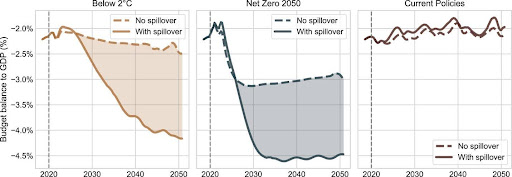
The analysis shows Indonesia’s budget balance declines primarily due to reductions in mining-sector tax revenues. 21 This illustrates how spillover risks, combined with domestic decarbonization measures, can create trade-offs between financial stability and the low-carbon transition.22 These dynamics highlight the significant fiscal challenges faced by countries like Indonesia as global climate policies generate spillover effects. A key challenge is determining how countries can navigate this inevitable market shift while ensuring fiscal preparedness.
Opportunities for Diversification
Countries like Indonesia face growing pressure from transition-related spillover risks and therefore need to diversify their economies.23 As climate policy aims to cut emissions and shift energy systems from fossil fuels to renewables, demand for critical minerals becomes essential for building the new green economy. Yet projections from the International Energy Agency show that mining for critical minerals will remain far smaller than the scale of fossil fuel extraction today, with less than thirty million tons needed for clean-energy technologies by 2040.24
Even so, this shift presents meaningful opportunities for Indonesia. The country is the world’s leading refiner of nickel, a strategic mineral for clean-energy technologies, while China dominates other parts of the supply chain.25 Indonesia accounts for fifty-one percent of global nickel mine production, and the government aims to attract more than IDR 3,800 trillion (approximately US 228.3 billion) in investment over the next five years to expand downstream industries for fifteen priority commodities, including nickel, copper, bauxite, and steel.26 Developing these industries could create new revenue streams that reduce fiscal vulnerability as Indonesia gradually moves away from fossil fuels.
A Call for Coordinated Climate Mitigation
Diversification alone, however, does not eliminate exposure to spillover risks. As critical minerals become more central to the global energy transition, trade-related spillovers are beginning to emerge. Indonesia may be a key player in the global nickel market, but China continues to dominate many segments of the supply chain. Ongoing export controls on critical minerals heighten supply chain vulnerabilities and pose risks to both energy security and economic stability.27 As Indonesia phases out fossil fuels and scales up renewables, it remains exposed on multiple fronts, including fiscal risks arising from global market disruptions.28
These challenges highlight the need for early and coordinated climate action across regions. For instance, the Association of Southeast Asian Nations (ASEAN) has introduced the ASEAN Strategy for Carbon Neutrality. However, the framework still lacks explicit consideration of spillover effects, particularly those that threaten financial stability.29 Stronger coordination would maximize positive spillovers, such as technology transfer and policy learning, while minimizing negative ones, such as trade disruption and fiscal strain, for low- and middle-income countries navigating the transition to a low-carbon economy.30
Without such coordination, the burden of transition will fall disproportionately on developing economies reliant on fossil fuel exports. Enhanced multilateral coordination, supported by international institutions and regional bodies, is therefore essential for ensuring that the global energy transition is both effective and equitable.
Works Cited
-
- de Carvalho, F. 2025. “Belém COP30 Delivers Climate Finance Boost and a Pledge to Plan Fossil Fuel Transition.” UN News, November 22. https://news.un.org/en/story/2025/11/1166433?_gl=1*1uq543y*_ga*Nzc5MjYzNzkzLjE3NjI4ODk3MDc.*_ga_TK9BQL5X7Z*czE3NjQ4OTkzNTEkbzMkZzAkdDE3NjQ4OTkzNTEkajYwJGwwJGgw.
- Simon, J., M. Cople, and R. Hersher. 2025. “U.N. Climate Talks End Without Agreement on Phasing Out Fossil Fuels.” NPR, November 22. https://www.npr.org/2025/11/22/nx-s1-5615207/u-n-climate-talks-end-cop30-brazil.
- Organisation for Economic Co-operation and Development (OECD), International Monetary Fund, United Nations Conference on Trade and Development (UNCTAD), World Bank, and World Trade Organization (WTO). 2024. Working Together for Better Climate Action: Carbon Pricing, Policy Spillovers, and Global Climate Goals. OECD Publishing. https://doi.org/10.1787/2b90fa2c-en.
- Gourdel, R., I. Monasterolo, and K. Gallagher. 2025. “Climate Transition Spillovers and Sovereign Risk: Evidence from Indonesia.” Energy Economics 143: 108211. https://doi.org/10.1016/j.eneco.2025.108211.
- Rodrik, D. 2015. “Green Industrial Policy.” Oxford Review of Economic Policy 30 (1): 469–491. https://doi.org/10.1093/oxrep/gru025.
- Mehling, M. A. 2024. Good Spillover, Bad Spillover? Industrial Policy, Trade, and the Political Economy of Decarbonization. Discussion Paper ES 2024-12. Cambridge, MA: Harvard Project on Climate Agreements.
- Ibid.
- Organisation for Economic Co-operation and Development (OECD), International Monetary Fund, United Nations Conference on Trade and Development (UNCTAD), World Bank, and World Trade Organization (WTO). 2024. Working Together for Better Climate Action: Carbon Pricing, Policy Spillovers, and Global Climate Goals. OECD Publishing. https://doi.org/10.1787/2b90fa2c-en.
- Ibid.
- Zenios, S. A. 2022. “The Risks from Climate Change to Sovereign Debt.” Climatic Change 172 (3). https://doi.org/10.1007/s10584-022-03373-4.
- Gourdel, R., I. Monasterolo, and K. Gallagher. 2025. “Climate Transition Spillovers and Sovereign Risk: Evidence from Indonesia.” Energy Economics 143: 108211. https://doi.org/10.1016/j.eneco.2025.108211.
- Mehling, M. A. 2024. Good Spillover, Bad Spillover? Industrial Policy, Trade, and the Political Economy of Decarbonization. Discussion Paper ES 2024-12. Cambridge, MA: Harvard Project on Climate Agreements.
- Organisation for Economic Co-operation and Development (OECD), International Monetary Fund, United Nations Conference on Trade and Development (UNCTAD), World Bank, and World Trade Organization (WTO). 2024. Working Together for Better Climate Action: Carbon Pricing, Policy Spillovers, and Global Climate Goals. OECD Publishing. https://doi.org/10.1787/2b90fa2c-en.
- International Energy Agency. 2023. “Indonesia: Coal.” IEA, Paris. https://www.iea.org/countries/indonesia/coal.
- Ministry of Energy and Mineral Resources Republic of Indonesia. 2024. Handbook of Energy and Economics Statistics of Indonesia. https://www.esdm.go.id/assets/media/content/content-handbook-of-energy-and-economic-statistics-of-indonesia-2024.pdf.
- Setiawan, D. 2025. “Indonesia’s Coal Sector at a Crossroads as Output Set to Fall.” In Chasing Volume, Losing Value: The Cost of Coal Over Expansion in Indonesia. Ember. https://ember-energy.org/latest-insights/chasing-volume-losing-value-the-cost-of-coal-over-expansion-in-indonesia/indonesias-coal-sector-at-a-crossroads-as-output-s/.
- Ibid.
- Ministry of Energy and Mineral Resources Republic of Indonesia. 2024. Handbook of Energy and Economics Statistics of Indonesia. https://www.esdm.go.id/assets/media/content/content-handbook-of-energy-and-economic-statistics-of-indonesia-2024.pdf.
- World Resources Institute. 2025. “STATEMENT: Indonesia Submits Its National Climate Commitment with New Emissions Targets Ahead of COP30.” WRI, October 30. https://www.wri.org/news/statement-indonesia-submits-its-national-climate-commitment-new-emissions-targets-ahead-cop30.
- Enerdata. 2025. “Indonesia’s Updated NDC Aims to Achieve Peak in GHG Emissions by 2030.” Enerdata, October 29. https://www.enerdata.net/publications/daily-energy-news/indonesias-updated-ndc-aims-achieve-peak-ghg-emissions-2030.html.
- Gourdel, R., I. Monasterolo, and K. Gallagher. 2025. “Climate Transition Spillovers and Sovereign Risk: Evidence from Indonesia.” Energy Economics 143: 108211. https://doi.org/10.1016/j.eneco.2025.108211.
- Ibid.
- Mercure, J.-F., P. Salas, P. Vercoulen, N. Chewpreecha, N. R. Edwards, et al. 2021. “Reframing Incentives for Climate Policy Action.” Nature Energy 6 (12): 1133–1143. https://doi.org/10.1038/s41560-021-00934-2.
- International Energy Agency. 2023. World Energy Outlook 2023. IEA, Paris. https://www.iea.org/reports/world-energy-outlook-2023.
- Ibid.
- International Energy Agency. 2025. “With New Export Controls on Critical Minerals, Supply Concentration Risks Become Reality.” IEA, Paris. https://www.iea.org/commentaries/with-new-export-controls-on-critical-minerals-supply-concentration-risks-become-reality.
- Indonesia Investment Coordinating Board. 2025. “Critical Minerals Downstreaming to Advance Indonesia’s Green Economy.” BKPM, October 11. https://www.bkpm.go.id/en/info/press-release/critical-minerals-downstreaming-to-advance-indonesia-s-green-economy.
- Magacho, G., E. Espagne, A. Godine, et al. 2023. “Macroeconomic Exposure of Developing Economies to Low-Carbon Transition.” World Development 167: 106231. https://doi.org/10.1016/j.worlddev.2023.106231.
- ASEAN. 2023. “ASEAN Strategy for Carbon Neutrality.” https://asean.org/wp-content/uploads/2023/08/Brochure-ASEAN-Strategy-for-Carbon-Neutrality-Public-Summary-1.pdf.
- Organisation for Economic Co-operation and Development (OECD), International Monetary Fund, United Nations Conference on Trade and Development (UNCTAD), World Bank, and World Trade Organization (WTO). 2024. Working Together for Better Climate Action: Carbon Pricing, Policy Spillovers, and Global Climate Goals. OECD Publishing. https://doi.org/10.1787/2b90fa2c-en.
Author Bio

Florencia Malau is a first-year MPA candidate at Cornell University’s Jeb E. Brooks School of Public Policy, concentrating in Economic Policy. She holds a bachelor’s degree in fiscal administration and previously worked in consulting specializing in international tax and transfer pricing, where she advised multinational companies on compliance, advisory, and dispute-resolution matters across diverse industries. Building on her private-sector experience, Florencia is transitioning into fiscal policy research and analysis. Her interests focus on economic behavior, revenue generation, and fiscal equity in both domestic and international contexts, with a particular emphasis on developing countries.