By: Thej Khanna
Edited By: Stephen Shiwei Wang
Introduction
As cities and states across the United States push for decarbonization and renewable energy transitions, smart grids have emerged as a central infrastructure for achieving cleaner, more resilient, and more efficient energy systems. Analysis shows that hundreds of utilities have already deployed advanced grid systems, although over 70 percent of the grid remains over 50 years old.1
The complexity of distributed generation, real-time grid management, and variable demand requires faster adaptations to existing operational models and infrastructure. Forecasts show increases in both electricity and peak demand, with electricity demand expected to grow by 25 percent by 2030 and 78 percent by 2050 compared to 2023 levels, driven by rapid growth in energy-intensive infrastructure and data centers.2 Data centers alone contribute significantly to this uptick in energy demand, with data center energy demand expected to reach 106 gigawatts (GW) by 2035.3
Additionally, heightened weather volatility driven by anthropogenic climate change places increased stress on outdated energy infrastructure, with 80 percent of all major U.S. power outages between 2000 and 2023 being caused by weather.4 These threats are compounded by the fragmented nature of the United States’ power grid, which is divided into three sections—the Eastern, Western, and ERCOT interconnections—all of which are almost entirely disconnected.5 The consequences of this fragmented system extend beyond the bureaucratic red tape associated with three separate grid systems composed of an even larger number of sub-operators: the 2021 winter power outages in Texas were directly related to the sequestered nature of state power infrastructure, resulting in the death of over 50 people.6
Agentic artificial intelligence (AI) workflows—autonomous systems capable of analyzing data, optimizing power flow, and coordinating resources—offer a potential solution. Through the establishment of a “unified agentic grid” and a public-private collaboration, a more reliable, resilient, and future-proofed grid is possible.
Defining Smart Grid Systems and the “Unified Agentic Grid”
Smart grids are electricity networks that employ digital technology, sensors, and software solutions to accurately and efficiently match real-time power supply and demand.7 Replacing traditional one-directional grid models, these “smart” infrastructures are multi-directional and data-driven, enabling heightened insights into energy use, demand, and need.8
Agentic AI offers a potential path to orchestrate the increasing complexity of energy grids. Using autonomous AI agents that coordinate, act, and decide with minimal human intervention, agentic workflows offload and automate time and labor-intensive operations. Possible agentic use-cases include systems that autonomously forecast demand, analyze grid congestion, adjust voltage, and shift distributed resources to prevent outages during extreme weather events. Appetite for AI-mediated grid systems is also evident, with 94 percent of utility executives expecting AI to contribute to revenue growth in the next three years.9
A unified data platform is critical in enabling agentic orchestration on the grid. Such a platform connects siloed data sources into a single, accessible system, enabling cohesive visibility and operations on fragmented information.10 This unified data layer is essential for enabling agentic systems to operate safely and effectively; without it, automated workflows would act on fragmented, inconsistent, or incomplete information. The energy private sector is already pushing for similar platforms, with 76 percent of energy-sector respondents surveyed by Siemens reporting that their organizations plan to invest in data integration technologies, and 68 percent seeing autonomous grid systems as crucial to reducing greenhouse gas emissions.11
The benefits associated with a unified agentic data platform introduce parallel risks, however. Smart grids operate on large, granular, and real-time streams of energy data, raising questions about consumer privacy and accurate operations on messy data. Automation also complicates accountability, with the question of who is responsible for rogue agentic actions remaining unanswered. For example, if an autonomous voltage-regulation agent lowers the voltage too aggressively and causes equipment damage, it remains unclear whether liability would lie with the utility, the vendor, or the public authority overseeing the grid. These governance gaps become more consequential as agentic systems assume higher-stakes operational roles, particularly those directly affecting power service.
Moreover, as agentic systems are still in a relatively early stage, integrating them into critical infrastructure poses a potential cybersecurity risk. Improper governance of agents, particularly in access control, dramatically expands attack vectors and creates silent failure states in which a single compromised credential can trigger cascading machine-speed disruptions.12 Without unified oversight, governance, and security standards for agentic systems, utilities cannot responsibly ensure accountability for agentic actions or defend against adversarial manipulation at scale.
Sample Smart Grid Agentic Unified Platform Diagram
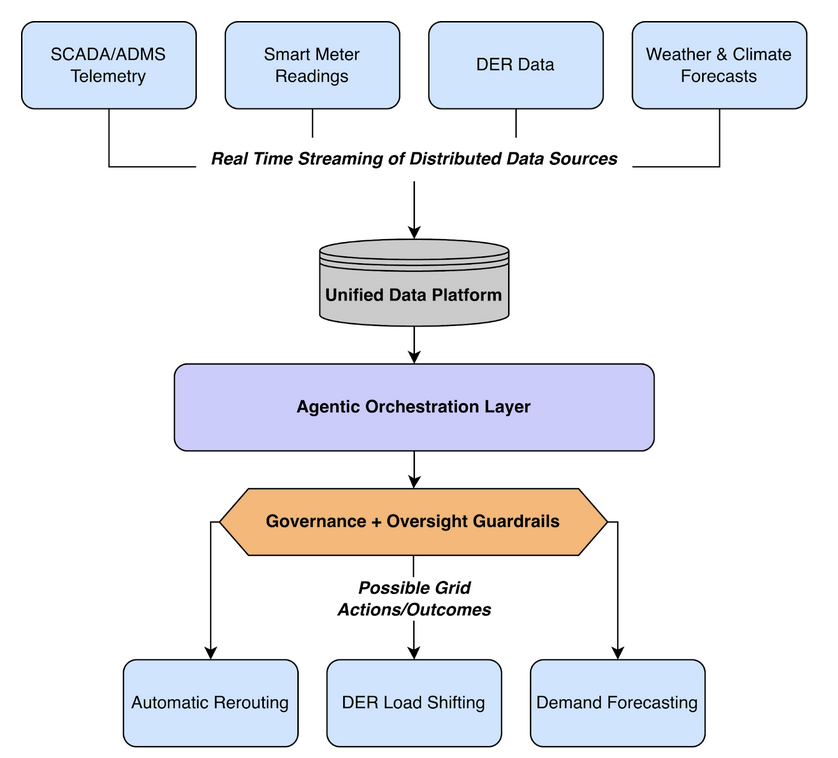
Understanding both the promise and constraints of agentic smart grids sets the stage for analyzing how the public sector, in partnership with private industry, should shape its development and deployment.
Local Public-Private Partnerships as the Path Forward
Public-private partnerships (PPPs) represent a critical path forward for implementing agentic smart grid upgrades, reducing public-sector financial and operational risk while infusing projects with capital and technical expertise. PPPs have a unique contract design that differs from the traditional US design-bid-build delivery format. It gives ownership to the private partner and incentivizes innovation and asset maintenance.13 This means municipalities can access private-sector technical advancements in AI-driven grid optimization, demand-response automation, and predictive maintenance. For example, utilities have already begun using AI tools to monitor transmission lines, predict supply and demand fluctuations, tailor energy models for individual homes, determine and respond to EV charging surges, and forecast potential disasters and outages.14 15 These collaborations demonstrate the potential of PPPs to supplement the public sector’s technical capacities.
These PPPs are not without their governance pitfalls, however, particularly when deploying agentic solutions. Some of these risks, and potential policy responses, are outlined in the following table:
|
Risk |
Description |
Policy Response |
|
Limited Visibility |
AI models face challenges with explainability, creating risks when AI—instead of a human—makes decisions for the entire grid |
Mandate explainability, bias audits, and logging of all agentic access and operations. |
|
Vendor lock-in |
Switching providers becomes costly, reducing public control |
Interoperability and open standards requirements |
|
Data-sharing agreements |
Utilities may share sensitive consumer data with vendors, amplified by the real-time, granular nature of energy data. |
Strict data privacy requirements, including, but not limited to, transparency in data collected and used, and anonymization of datasets. |
|
Misaligned incentives |
Private vendors may pursue profit rather than resilience |
Public-interest clauses in all PPP contracts and equity stakes for private partners |
|
Expertise imbalance |
Vendors may technically overpower municipalities due to their heightened knowledge of and control over systems. |
Technical capacity building within the public sector through targeted recruitment of civic technologists. |
A well-designed PPP contract must include transparency requirements, clear data-governance rules, open auditability of AI workflows, and public-interest clauses that prioritize reliability, equity, and community benefit over purely commercial objectives. If local governments adopt these guardrails, PPPs can provide a powerful mechanism for deploying agentic energy systems responsibly and effectively.
Recommendations
- Local governments should invest in roles for civic technologists—including AI Governance Leads, Chief Data Officers, and embedded data engineers—to build internal capacity to evaluate, audit, and oversee agentic grid systems. These roles should play a critical role in defining data governance, interoperability, and safety guardrails.
- State and federal governments should deploy a mix of tax incentives, municipal bond financing, and DOE-backed programs to reduce upfront capital costs and encourage private-sector participation in unified grid modernization efforts.
- Government offices should define strict guardrails for PPPs, emphasizing transparency in agentic workflows, accountability measures, and baseline cybersecurity and data-privacy protections.
Conclusion
The creation of a unified agentic grid is a critical step in establishing energy stability in the United States, a need compounded by growing energy demand, increasing weather volatility, and the push towards decarbonization and renewable energy. By integrating public oversight with private technological innovation and by establishing a unified governance platform to anchor this collaboration, policymakers can ensure that the future grid is not only intelligent but also equitable, secure, and resilient. The success of the nation’s energy transition will depend not just on technological advancement, but on the partnerships that support it.
Works Cited
- Hack, Joe. 2025. “How Advanced Transmission Technologies Can Revamp the Aging US Power Grid”. World Resources Institute. Published July 10. https://www.wri.org/insights/advanced-transmission-technologies-us-power-grid.
- Batra, Lalit, Deb Harris, George Katsigiannakis, Justin Mackovyak, Himali Parmar, and Maria Scheller. 2025. “Rising Current: America’s Growing Electricity Demand.” ICF. https://www.icf.com/insights/energy/impact-rapid-demand-growth-us.
- BloombergNEF. 2025. “AI and the Power Grid: Where the Rubber Meets the Road,” BloombergNEF. Published December 1. https://about.bnef.com/insights/clean-energy/ai-and-the-power-grid-where-the-rubber-meets-the-road/.
- Climate Central. 2024. “Weather-Related Power Outages Rising.” Climate Central. Published April 24. https://www.climatecentral.org/climate-matters/weather-related-power-outages-rising.
- Einberger, Mathias. 2023. “Reality Check: The United States Has the Only Major Power Grid without a Plan.” RMI. Published January 12. https://rmi.org/the-united-states-has-the-only-major-power-grid-without-a-plan/.
- Norton, Kara. 2021. “Why Texas Was Not Prepared for Winter Storm Uri.” PBS NOVA, March 25, 2021. https://www.pbs.org/wgbh/nova/article/texas-winter-storm-uri/.
- International Energy Agency (IEA). 2025. “Smart Grids.” IEA. https://www.iea.org/energy-system/electricity/smart-grids.
- National Institute of Standards and Technology (NIST). 2019. Smart Grid: A Beginner’s Guide. National Institute of Standards and Technology. Last Update November 21. https://www.nist.gov/el/smart-grid-menu/about-smart-grid/smart-grid-beginners-guide.
- Habib, Zahid, Biren Gandhi, Roger Hasson, Shannon Wilson, Phil Spring, Olivier Payraud, Dalida Alley, Keiji Iwata, Kenichi Watanabe, Ravi Kumar Mandalika, and Rubens Del Monte. 2025. “Utilities in the AI Era: Powering Ahead to a Smarter Future.” IBM Institute for Business Value. Published November 19. https://www.ibm.com/thought-leadership/institute-business-value/en-us/report/utilities-in-ai-era.
- Patterson, Brooks. 2025. “Unified Data Platform: How It Works & Why You Need One.” RudderStack. Published October 22. https://www.rudderstack.com/blog/unified-data-platform/.
- Siemens AG. 2025. Infrastructure Transition Monitor 2025. Siemens. https://www.siemens.com/global/en/company/insights/infrastructure-transition-monitor-2025.html.
- Hidary, Jack. 2025. “Non-Human Identities: Agentic AI’s New Frontier of Cybersecurity Risk.” World Economic Forum. Published October 15. https://www.weforum.org/stories/2025/10/non-human-identities-ai-cybersecurity/.
- Engel, Eduardo, Ronald D. Fischer, and Alexander Galetovic. 2014. The Economics of Public-Private Partnerships: A Basic Guide. Cambridge: Cambridge University Press.
- Irving, Doug. 2025. “AI and the Future of the U.S. Electric Grid.” RAND Corporation, Published April 4. https://www.rand.org/pubs/articles/2025/ai-and-the-future-of-the-us-electric-grid.html.
- Kim, June. 2023. “Four Ways AI Is Making the Power Grid Faster and More Resilient.” MIT Technology Review. Published November 22. https://www.technologyreview.com/2023/11/22/1083792/ai-power-grid-improvement/.
Author Bio

Thej Khanna is a fourth-year undergraduate student pursuing a B.A. in English Literature at Cornell University’s College of Arts & Sciences. He is passionate about technology and civil rights and with a focus on surveillance, digital privacy, and emerging technology. Combining these interests, he hopes to explore a career at the intersections of legal advocacy and tech policy. Thej is a College of Arts & Sciences Nexus Scholar, and has formerly worked at the Bronx District Attorney’s Office and the Surveillance Technology Oversight Project.