
By: Enomy Germain
Edited By: Stephen Shiwei Wang
Introduction
Emigration has long been a defining feature of Haiti’s modern history and has generated strong economic linkages between the country and its diaspora, particularly in the United States. Remittances sent by Haitian migrants have become a central pillar of the Haitian economy, accounting for approximately 20 percent of the country’s gross domestic product (GDP) in recent years1, making the country one of the most remittance-dependent economies in the world. Moreover, these transfers play a critical role in sustaining household consumption and helping many households avoid falling into extreme poverty in a country where roughly 60 percent of the population lives below the poverty line.2 In other words, the Haitian economy depends heavily on remittance inflows at both the microeconomic and macroeconomic levels.
Given this dependence, immigration policy in the United States, where roughly 70 percent of remittances to Haiti originate according to the Central Bank of Haiti, may have implications that extend beyond migration management itself. Immigration policies adopted under the administration of Donald Trump have generally reflected a more restrictive approach toward migrants, including greater uncertainty surrounding temporary protection programs. For Haitian migrants, such policies may affect not only their legal status and employment opportunities but also their ability to maintain financial ties with relatives in Haiti. Because these transfers are central to the Haitian economy, any disruption to remittance flows could further exacerbate the country’s long-standing economic crisis. Recent public statements by the U.S. Department of Homeland Security (DHS) have reinforced these concerns. In a post published on its official X account, DHS criticized remittance transfers from the United States to Haiti, describing them as a form of economic subsidy to foreign economies and suggesting that such flows should be restricted.3
This paper examines how restrictive immigration policies adopted during the administration of Donald Trump could deepen Haiti’s economic vulnerability by altering migration dynamics and remittance flows from Haitian migrants in the United States.
Migration and the formation of the Haitian diaspora
Over the past century, Haitian migrations have evolved through several distinct waves shaped by changing political, economic, and social conditions. Four of these waves are documented by Paul Austin.4 The first began in the early twentieth century, when Haitians migrated primarily to France, influenced in part by historical and cultural ties between the two countries. A second wave emerged during the period of the United States’ occupation of Haiti (1915–1934), when Haitian workers migrated to work in North American-owned agricultural and agro-industrial enterprises located mainly in the Dominican Republic and Cuba. A third wave, spanning roughly from the 1950s to the late 1960s, was largely political in nature. During this period, many Haitians left the country to escape political repression, with a significant share migrating to the United States. The fourth wave, which extended from the late 1960s to the early 2000s, according to the authors, was driven primarily by economic factors. Faced with limited economic opportunities at home, many Haitians sought better livelihoods abroad, again with the United States as the main destination.
I then argue that since the mid-2000s, a fifth wave of migration has been unfolding. This most recent movement reflects the accumulation of severe economic hardship, persistent political instability, and growing insecurity in Haiti. Haitian migrants in this wave increasingly moved not only to the United States but also to countries such as Canada and France. In many cases, migrants transit through several South American countries before attempting to reach North America.5 As part of this recent wave, thousands of Haitians have also benefited from various migration programs, including Temporary Protected Status (TPS) in the United States and Humanitarian Parole Programs introduced under the administration of Joe Biden.
As of 2024, according to estimates from the United Nations, the stock of Haitian migrants in the United States increased by around 244 percent from 1990 to 2024, reaching approximately 798,232 individuals in 2024, of whom about 54 percent are women and 46 percent are men as shown in figure 1.6 Other estimates by the World Bank suggest that nearly 83.6 percent of Haitians with tertiary education live abroad, making Haiti one of the countries most affected by skilled emigration in the world.7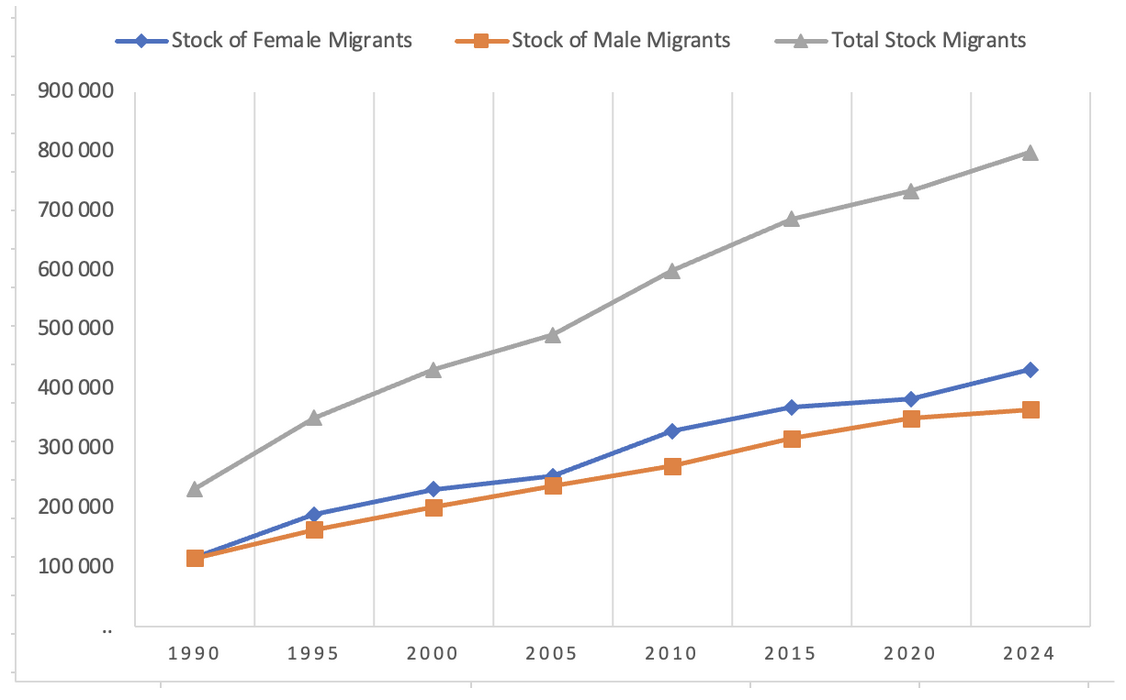
Figure 1: Stock of Haitian Migrant Stock from 1990 to 2024
Migrants contribute to the labor force and economic activity of their host countries in a variety of sectors, and this is also true for Haitian migrants.8 For the country of origin, however, relatively large-scale emigration may have ambiguous consequences, particularly when it results in the loss of highly skilled workers and reduces the domestic stock of human capital. At the same time, migration generates important economic benefits for the country, especially through the remittances that migrants send to their families.
Remittances and the Haitian Economy
The Haitian economy has experienced prolonged stagnation over the past several decades. Between 1990 and 2025, the country recorded an average annual GDP growth rate of only 0.58 percent, according to national accounts data compiled by the World Bank.9 During this thirty-five-year period, Haiti has not experienced a decade of stable and continuous growth. Therefore, its economic performance has been marked by repeated downturns and structural weaknesses that have contributed to the persistence of poverty.
More recently, the situation has deteriorated further. Between 2019 and 2025, what I describe as the “Seven Black Years”, the Haitian economy recorded seven consecutive years of negative growth. Over this period, the cumulative contraction of economic activity reached approximately 17.3 percent.
During these years of economic decline, traditional sources of foreign exchange have remained both limited and unstable. Foreign direct investment (FDI) has been particularly weak. According to data from UN Trade and Development (UNCTAD), FDI inflows declined from roughly USD 75 million in 2019 to about USD 30 million in 2025, reflecting both the deteriorating security situation and the broader decline in investor confidence.10 Export revenues have also weakened significantly. The value of Haitian exports fell from approximately USD 1.6 billion in 2018 to around USD 860 million in 2024, highlighting the structural fragility of the country’s productive sector.11
In this context of economic contraction and declining external revenues, remittances sent by the Haitian diaspora have become the most important source of foreign exchange for the country. Between 2018 and 2025, remittance inflows increased by about 50 percent, rising from roughly USD 3.3 billion to nearly USD 5 billion. Estimates by the Central Bank of Haiti suggest that approximately 70 percent of these transfers originate from the United States. This indicates that the Haitian diaspora in the United States plays a dominant role in sustaining remittance flows to Haiti.
As illustrated in Figure 2, remittances largely exceed both foreign direct investment and export revenues as sources of external financial inflows to Haiti. In practical terms, no other external flow currently plays a comparable role in bringing foreign currency into the economy.
Beyond their macroeconomic importance, remittances also play a crucial role at the household level. A study conducted by ProEco Haiti for the Embassy of Switzerland in Haiti indicates that nearly half of remittance income is used to finance essential household needs, particularly food consumption (33.1 percent) and education expenses (16.2 percent).12 Similar findings have been reported in United Nations studies on the use of remittances in Haiti.13
Taken together, remittances are central to the Haitian economy. They provide critical support to an economy already in decline while helping many vulnerable households avoid further deterioration in their living conditions.
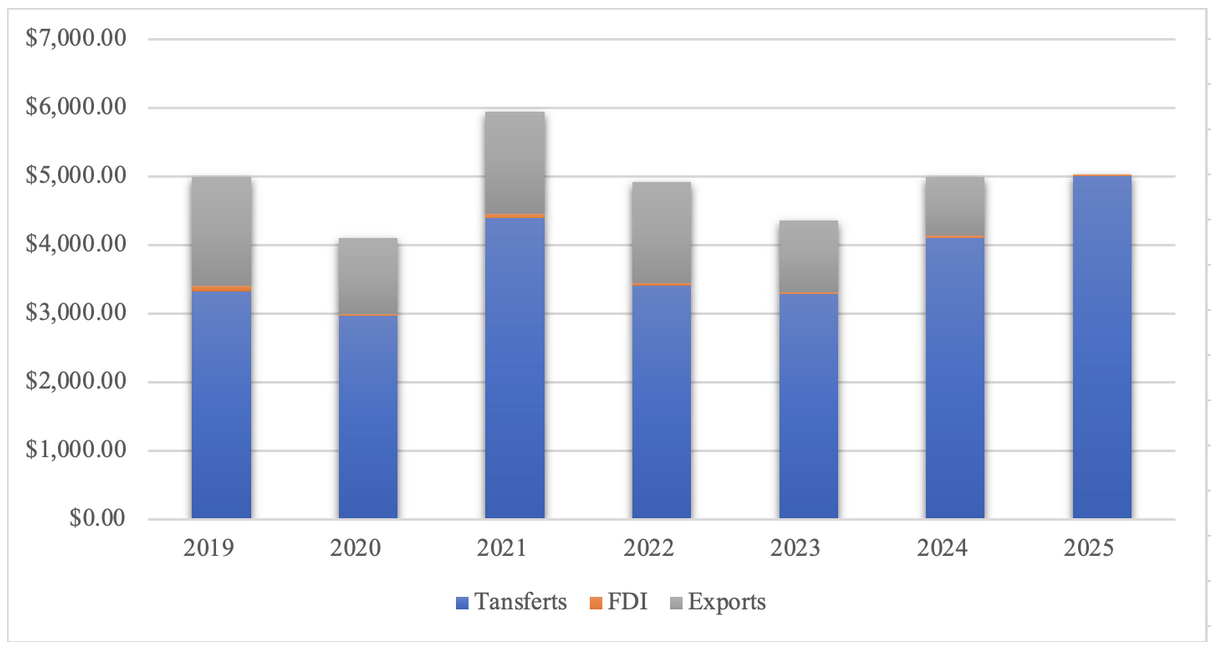
Figure 2: Remittances Compared with Foreign Direct Investment and Exports in Haiti, 2019–2025
Current U.S. Immigration Policy Toward Haitian Migrants and Its Economic Implications for Haiti
Current immigration policy in the United States toward Haitian migrants is marked by both restriction and uncertainty. One of the most important policy instruments affecting Haitian migrants has been the Temporary Protected Status (TPS). Haiti’s TPS designation was scheduled to terminate on February 3, 2026, but according to the U.S. Citizenship and Immigration Services (USCIS), a federal court order issued shortly before that date temporarily preserved TPS protections and the validity of related documentation while litigation continues. As a result, TPS protections for Haitian migrants have not fully disappeared, but their future remains uncertain.14
At the same time, other migration pathways narrowed. On March 25, 2025, the U.S. Department of Homeland Security published a notice in the Federal Register terminating the humanitarian parole processes for nationals of Cuba, Haiti, Nicaragua, and Venezuela (CHNV). The program, originally introduced in 2022–2023 to provide temporary entry and work authorization to migrants from these countries, allowed up to 30,000 individuals per month to enter the United States under humanitarian parole.15 The termination notice stated that the parole status of beneficiaries would end by April 24, 2025 if no alternative legal status was obtained.
Recent public statements by the U.S. Department of Homeland Security have reinforced these concerns. In a post published on its official X account, DHS explicitly criticized remittance transfers to Haiti, describing them as a drain on the U.S. economy and signalling hostility toward the continuation of such flows. While this statement is not a formal regulation, it is politically significant because it frames remittances not as private family transfers but as a policy problem. That framing matters for a country like Haiti, where remittances account for about one-fifth of GDP and play a central role in household survival.
For Haiti, the economic implications of such policy changes could be significant. A more restrictive immigration environment may weaken the legal and economic stability of Haitian migrants in the United States. Because remittance-sending capacity depends directly on migrants’ employment opportunities, income stability, and legal status, increased uncertainty may affect both the volume and regularity of transfers sent to relatives in Haiti.
Any disruption to these flows could therefore amplify existing macroeconomic vulnerabilities. In a country where roughly 50 percent of the population lives in conditions of food insecurity, restricting remittance flows could trigger a more severe humanitarian crisis, as it would reduce household purchasing power, weaken domestic consumption, and diminish the supply of foreign currency available to the economy.16
Moreover, policies that increase the cost or difficulty of sending remittances would run counter to international development commitments. In particular, they would undermine Target 10.c of the United Nations Sustainable Development Goals (SDGs), which aims to reduce the transaction costs of migrant remittances to below three percent by 2030 as part of global efforts to reduce inequalities among countries.17
Conclusion
Over the past decades, remittances sent by the Haitian diaspora — particularly those living in the United States — have become a central pillar of Haiti’s economy. In a context marked by prolonged economic stagnation, weak productive capacity, and limited social protection, these transfers have played an important role in enabling millions of Haitian households to sustain their livelihoods. They also represent one of the few stable sources of foreign exchange for an economy that has struggled to generate growth.
Yet this dependence also creates vulnerability. This paper argues that when a country relies heavily on migration-generated income, policy decisions made abroad can have direct economic consequences at home. The Haitian case therefore highlights a broader dilemma faced by remittance-dependent economies: migration policies adopted in host countries can influence economic outcomes far beyond their borders. For an economy already experiencing prolonged decline, restrictive immigration policies in the United States could therefore contribute to deepening Haiti’s ongoing economic collapse.
From a public policy perspective, this suggests the importance for developing economies of reducing excessive reliance on external income sources that lie largely outside their control. Strengthening domestic productive capacity and expanding internal sources of growth may therefore be essential to limit the economic risks associated with such dependence.
Work Cited
1. Banque de la République d’Haïti (BRH). 2024. Transferts sans contreparties : Tendances, distribution et dynamique du marché. https://www.brh.ht/wp-content/uploads/Transferts-sans-contreparties-tendance-distribution-et-dynamique-du-marche.pdf.
2. Germain, E. 2019. Pourquoi Haïti peut réussir : Un essai d’économie politique. Port-au-Prince, Haiti: C3 Éditions.
3. U.S. Department of Homeland Security. (2026, May 20). Post on X regarding remittances to Haiti. https://x.com/DHSgov/status/2028530867677675956.
4. Paul-Austin, L. C. 2015. 1915 et la diaspora : Le lieu et l’histoire dans la fabrication identitaire. In M. Soukar (Ed.), Cent ans de domination des États-Unis d’Amérique du Nord sur Haïti, 1915–2015. C3 Éditions.
5. Audebert, C. 2017. Refugees or economic migrants? The recent geodynamics of Haitian migration. Revista Brasileira de Estudos de População, 34(1), 55–71. https://rebep.emnuvens.com.br/revista/article/view/886.
6. United Nations, Department of Economic and Social Affairs, Population Division. 2024. International migrant stock. https://www.un.org/development/desa/pd/content/international-migrant-stock.
7. World Bank. 2011. Migration and remittances factbook. World Bank. https://openknowledge.worldbank.org/entities/publication/fbb41de4-a64a-5cb4-a0e8-a6c286f6371d.
8. Organisation for Economic Co-operation and Development (OECD) & International Labour Organization (ILO). 2018. How immigrants contribute to developing countries’ economies. OECD Publishing. https://www.oecd.org/en/publications/how-immigrants-contribute-to-developing-countries-economies_9789264288737-en.html.
9. World Bank. n.d. “GDP Growth (Annual %) – Haiti.” World Development Indicators. https://data.worldbank.org/indicator/NY.GDP.MKTP.KD.ZG?locations=HT.
10. UN Trade and Development (UNCTAD). n.d. World investment report. https://unctad.org/publications-search?f%5B0%5D=product%3A397.
11. World Bank. n.d. Exports of goods and services (current US$) – Haiti. https://data.worldbank.org/indicator/NE.EXP.GNFS.CD?locations=HT.
12. ProEco Haïti. n.d. Consulting Firm from Haiti. https://proecohaiti.com/.
13. Cadet, R. L. et al. 2016. Étude de marché sur les transferts d’argent en Haïti. Fédération des Caisses Populaires Haïtiennes. https://www.undp.org/sites/g/files/zskgke326/files/2022-06/undp-ht-Etude_TRANSFERTS_DIASPORA_versionFINALE_Juin_2022.pdf.
14. U.S. Citizenship and Immigration Services. n.d. Temporary Protected Status: Haiti. https://www.uscis.gov/humanitarian/temporary-protected-status/temporary-protected-status-designated-country-haiti.
15. U.S. Department of Homeland Security. 2025. Termination of parole processes for Cubans, Haitians, Nicaraguans, and Venezuelans. Federal Register, 90 FR 13611. https://www.govinfo.gov/app/details/FR-2025-03-25/2025-05128.
16. Integrated Food Security Phase Classification (IPC). 2024. Haiti acute food insecurity situation: August 2024–February 2025 and projection for March–June 2025. https://www.ipcinfo.org/fileadmin/user_upload/ipcinfo/docs/IPC_Haiti_Acute_Food_Insecurity_Aug2024_Jun2025_Snapshot_English.pdf.
17. United Nations. 2015. Transforming our world: The 2030 agenda for sustainable development. https://sdgs.un.org/goals/goal10.
Author Bio 

Enomy Germain, a Fulbright Scholar from Haiti, is a second-year MPA student at Cornell University specializing in Economic and Financial Policy. He has worked as a consultant in policy evaluation and public finance for several institutions, including the World Bank and the Superior Court for Audit and Administrative Litigation in Haiti. He has also served as an economic commentator in Haitian media for several years. His work focuses on addressing the structural causes of poverty in his country and contributing to evidence-based public policy solutions. He is also an author and has published a book titled Why Haiti Can Succeed: An Essay in Political Economy, in which he presents an optimistic perspective on Haiti’s future.