
By: Christian Bolden
Edited By: Stephan Shiwei Wang
Executive Summary
The U.S. economy is now underpinned by digital infrastructure, which includes data centers, broadband networks, cloud capacity, and the energy systems that support them. It drives developments in artificial intelligence, logistics, finance, and national security. As these systems expand, their physical footprint has shifted from invisible to contested. Over the past half decade, zoning conflicts, community opposition, and litigation have delayed or halted over $64 billion in development.1 This resistance is not anti-growth; it reflects a broader recognition whereby land use, energy planning, and digital infrastructure are intertwined forces that shape community continuity and identity.2 Infrastructure has emerged from the industrial shadows as a driver of ecological coherence, development trajectories, and cultural implications.
Legacy permitting models that are transactional, narrow, and anchored in assumed public benefit no longer meet community expectations. Infrastructure is increasingly being assessed by locals for its reciprocity, clarity, and compatibility with the area’s long-standing narrative. Legitimacy, understood as community, political, and institutional acceptance, has therefore become the governing constraint on digital-infrastructure expansion. Strong legitimacy maintains capital deployment and stabilizes approvals; weak legitimacy lengthens timelines, increases volatility, and fractures development landscapes.
The most obvious early evidence of this change is found in Virginia. Home to the world’s greatest concentration of digital infrastructure, the Commonwealth reveals that modern infrastructure decisions are influenced by four dimensions of legitimacy: cultural alignment, institutional trust, reciprocal benefit, and procedural integrity. Controversies in King George, Culpeper, and Prince William counties show that communities no longer assess projects solely by economic utility, but by what they signal for local identity and the future shape of place.3, 4, 5
The Responsible Growth framework responds to this new environment by providing a structure for evaluating the coherence between infrastructure scale, community identity, and regional energy demands. The framework provides a conceptual structure that enables governments, utilities, and developers to align digital infrastructure development with civic expectations to create institutionally stable frameworks and socially durable outcomes.
Market Landscape: The Era of Infrastructure Invisibility is Over
For much of its history, digital infrastructure was essentially invisible to the public: data centers ran in the background, employed few people, and occupied unnoticeable industrial space with little effect on nearby systems. That dynamic has shifted.6 Digital infrastructure has become a visible force, reshaping land use and community identity as expanding load growth and transmission needs intensify. This scale has resulted in significant public concern.7
Larger transmission corridors, new substations, and previously unheard-of electrical loads are now required for hyperscale facilities. People now connect these developments to their need for reliable services, stable rates, and sustainable environmental practices, making grid capacity a central civic concern. Land use determinations can also threaten housing affordability as rising housing costs make it difficult for people to stay in their communities.8 In combination, these factors have transformed infrastructure from a neutral entity into a force which determines how communities identity, manage land utility, and narrate its character. Public concern centers not only on what is built but also on how the community will change because of it. Digital infrastructure is now understood as a social system as much as a technical one.9
The White House’s Genesis Mission intensifies these dynamics by accelerating national-scale AI and high-performance computing, increasing pressure on regional grids, transmission corridors, and siting processes.10 In this environment, local institutional alignment, community-identity coherence, and procedural legitimacy become decisive gatekeepers for whether federally aligned infrastructure can advance. The Genesis Mission underscores that federal acceleration makes local legitimacy the binding constraint on national digital-infrastructure strategy.
The Core Problem: The Erosion of Local Legitimacy
The central challenge for digital-infrastructure expansion in the United States is no longer technical feasibility or capital. Rather, the greatest obstacle is now local legitimacy. Trust is interpersonal, but legitimacy is institutional and determines whether communities view a data center as aligned with their values and expectations. In infrastructure development, legitimacy, not trust, governs acceptance and social durability.11 Communities now assess data center proposals through meaning and identity rather than economic impact. This is largely because the material and infrastructural systems that support digital services remain obscured from public view and require institutional translation to become socially legible.12
The presumptive social contract which supported local growth through employment and financial support has weakened.13 Digital infrastructure disrupts that model: data centers employ few residents, occupy large physical and electrical footprints, and require long-horizon planning that extends beyond political cycles.14 As a result, communities increasingly ask not what a project yields economically, but what their community becomes if it is built. Legitimacy fractures when development appears misaligned with residents’ history, landscape, and civic identity.15
Legitimacy is the structural foundation that enables public trust and attracts long-term investment in digital infrastructure. Rather than persuasion, government and industry must pursue alignment to ensure development reflects the values and priorities of the community. Without this alignment, volatility grows, timelines drift, and approvals remain fragile.
Strategic Risks if Industry Does Not Adapt
The legacy infrastructure siting model which assumes economic benefits are obvious and public approval is automatic only leads to increasingly hostile development environments. When development lacks legitimacy, community distrust often escalates into organized opposition, generating political headwinds that delay projects and increase sunk costs.16 The effects of this misalignment are increasingly evident:
- Capital risk escalates as investors price uncertainty into timelines.
- Permitting becomes vulnerable to political turnover, appeals, and delay.
- Utilities struggle to forecast load and justify capacity investments.
- Workforce and housing pressures intensify as growth outpaces planning.
- Reputational risk increases as companies are judged not just by what they build, but by whether communities believe they are building with them.
The accumulation of unresolved conflicts creates a cascading effect that shifts development from collaborative planning to defensive, transactional decision-making. This instability produces delays, political criticism, and reduced operational efficiency. In the context of the digital economy, these conflicts pose significant risks because they unfold across large-scale physical systems.
Sector Interdependence: Digital Infrastructure, Energy Planning, Housing Stability, and Civic Identity
Housing, energy, and digital infrastructure are increasingly understood as interdependent systems rather than separate policy verticals.17 They are, instead, interdependent systems that directly impact one another. Large-scale computing produces compound energy loads that not only require expansive distribution infrastructure and transmission networks, but also additional generation resources. Energy sourcing and site selection decisions influence urban growth, reshape landscapes, and establish new development boundaries. Land-use decisions that establish school zones, commute patterns, property values, and general community stability all influence housing options. As a result, infrastructure is increasingly interpreted via displacement pressure, even when the relationship is indirect.18, 19
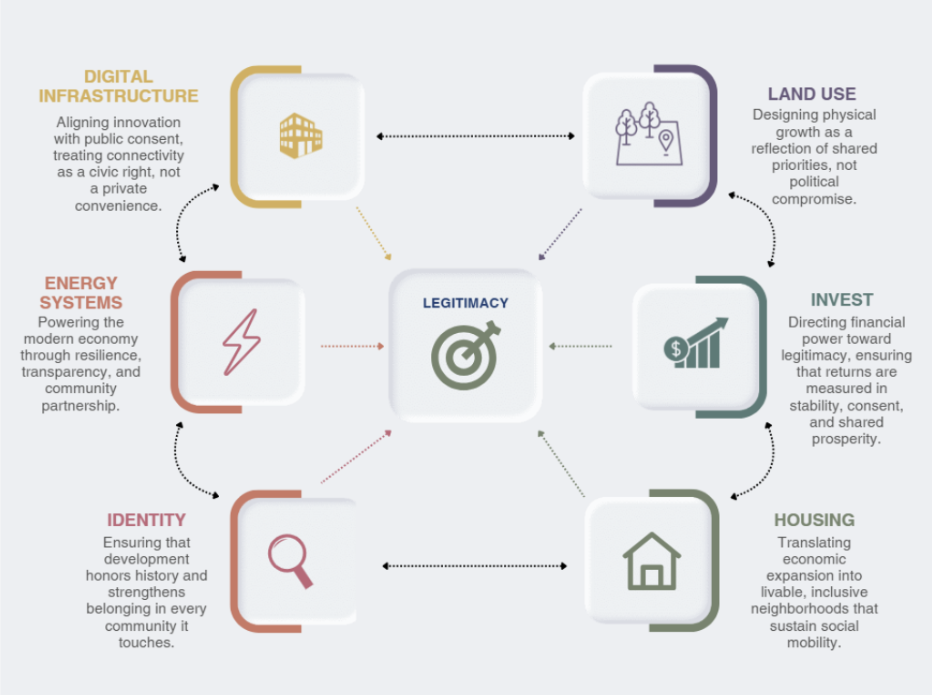
The approval process for data centers therefore requires coordinated decisions about energy demand, land use, housing needs, and the preservation of community identity. When these systems are treated separately, legitimacy breakdowns are inevitable. Conversely, when planned as a single civic ecosystem, development becomes more durable, stable, and reciprocal. This integrated design logic is what Responsible Growth formalizes.
The Regionalization of Legitimacy in Digital-Infrastructure Governance
Virginia is North America’s digital-infrastructure capital, with Northern Virginia hosting the world’s largest concentration of hyperscale data centers.20 The benefits to the Commonwealth are enumerable as decades of advantageous tax policy, fiber density, and proximity to federal networks undergird its economy. Loudoun County represents the apex of this model: low-visibility siting and nonresidential buffering enabled massive build-out with limited public conflict. But once load growth demanded new substations, transmission lines, and visible land-use changes, the infrastructure became socially legible, revealing the limits of a growth paradigm built on invisibility and exposing how legitimacy erodes when scale exceeds community expectations.21
“Prince William and Culpeper counties demonstrate that legitimacy has become the primary constraint on digital-infrastructure expansion. The Prince William Digital Gateway [[project]] ignited litigation, political turnover, and sustained resident mobilization because fiscal arguments collided with identity-based narratives rooted in heritage and landscape continuity.22, 23 Not coincidentally, Culpeper [[County experienced its own narrative shift around data centers:]] residents objected not from anti-growth ideology but from concerns about rural character, ecological cohesion, and long-term place meaning.24 In both counties, identity-based evaluation overtook economic logic as the dominant decision-making lens.”
We’re now seeing these dynamics diffuse across multiple jurisdictions. Caroline County evaluates new proposals against the patterns forged in Culpeper and Prince William, testing whether high-demand infrastructure aligns with rural identity, agricultural continuity, and transportation capacity. Chesterfield shows the same tension emerging in suburban contexts, where concerns center on neighborhood character, school capacity, and land-use coherence.25 These cases reveal that legitimacy risk is not geographically confined; it unfolds whenever infrastructure scale or pace diverges from a community’s perceived trajectory of place, creating statewide governance pressure as Virginia prepares to address grid modernization, siting authority, transmission planning, and digital-infrastructure regulation in the 2026 session.
Similar patterns are emerging beyond Virginia. Prince George’s County, Maryland, created a Data Center Task Force in 2025 and issued the Qualified Data Centers Report recommending new siting criteria, environmental reviews, and procedural guardrails after temporarily pausing approvals.26 The report demonstrates how a major Mid-Atlantic jurisdiction now interprets data-center development as a matter of civic approval rather than standard industrial growth, even in an advisory capacity. Its focus on grid capacity, site identity alignment, natural landscape protection, and long-term development planning mirrors patterns emerging in Virginia, signaling the maturation of a legitimacy-based governance model. Prince George’s stands as an early indicator that jurisdictions and industry lacking integrated frameworks risk reactive, piecemeal decision-making in a rapidly accelerating national infrastructure environment.
Responsible Growth as a Strategic Operating Philosophy
Government and industry must transition from transactional permitting to relational, structural coordination to succeed in this shifting environment. The Responsible Growth philosophy provides the framework for digital infrastructure development in the United States with legitimacy now having outsized influence on market viability.
Responsible Growth acknowledges that digital infrastructure, energy systems, housing markets, and community identity form a single interdependent civic system. Decisions in one domain impact the outcomes of the others. Therefore, data center development is an energy planning decision, a land use decision, and a decision about community identity. Grid expansion signals a regional development trajectory. Land conversion signals cultural continuity or disruption.
Under Responsible Growth, development is not technical alone. It is defined as involvement in a common civic future rather than the completion of a discrete project. The philosophy asserts three core principles:
- Legitimacy is not a communications task; rather, it is a structural factor that determines long-term operating stability.
- Communities must be able to identify and experience the reciprocal benefits of growth.
- Cooperation is determined by decision integrity; transparent and predictable approval processes increase public confidence.
Fundamentally, this solution addresses the newfound reality that an approval obtained without legitimacy is fragile, but an approval based on trust is durable, and that longevity is the new currency when governing complex growth.
The Responsible Growth Model
Identity Mapping: Determine the cultural narratives, place-based meanings, and continuity that communities aim to preserve. This creates the foundation for legitimacy.
Grid–Land Synchronization: Align load planning for digital infrastructure with housing and land use trends. Avoid disconnects between communities’ ability to embrace growth and the availability of power.
Reciprocity Structuring: Design a shared-benefit model based on long-term stewardship, enduring, and visible. Benefits must be reciprocal rather than exclusive.
Time to Yes Alignment Review: Evaluate decision pathways for transparency, predictability, and narrative clarity evaluating approval barriers and mitigating adverse influences.
The Responsible Growth framework serves as a coordination architecture which supports how well institutions assess their projects, match community needs and regional development plans. When legitimacy is treated as a primary planning input, capital risk decreases, permitting stabilizes, utility forecasting becomes reliable, and community cooperation strengthens. As the cost of ignoring legitimacy is already shaping the operating environment of the digital economy, Responsible Growth mitigates adverse outcomes.
Strategic Recommendations for Industry and Public Sector Partners
To stabilize the development environment, industry and government must shift from transactional engagement and adopt a new coordination model. The question is not how to convince communities to accept infrastructure. The question should be how to design infrastructure with communities as co-authors of their regional future. Digital infrastructure strategy considerations should include:
- Integrate Planning Horizons. Digital infrastructure, energy strategy, and land use should be evaluated together as a symbiosis source of transformation, not in parallel. This calls for a common understanding of the impact and a common planning timeline, not new bureaucracy. When institutions engage in coordinated planning they create a coherent narrative of benefit rather than competing justifications.27
- Treat Identity as a Planning Parameter. Community identity is not a stakeholder management issue; it is a determinant of legitimacy. Developers must treat the communities not as uninitiated stakeholders, but active partners whose ideals of continuity, memory, heritage, rooted belonging are factored. Development that reinforces these foundations strengthens long-term acceptance and operational stability.
- Make Reciprocity Visible and Durable. Reciprocity cannot be deemed a concession. It should mean that communities can identify tangible, lasting benefits. This may include infrastructure improvements, environmental protections, workforce pathways, environmental stewardship commitments, or community access agreements. Shared value must be clear and enduring.
- Ensure Decision Integrity. Legitimacy requires the approval pathway to be transparent, consistent, and grounded in shared criteria. When the process is clear and predictable, cooperation increases even among those who may not fully agree.
- Communicate System Implications in Plain Language. Utilities and infrastructure developers should communicate resource impacts, grid conditions, and operational footprints in accessible terms. When communities understand why infrastructure is needed and how it functions, opposition decreases and trust increases.
The Responsible Growth framework gives industry the tools to lead. By subscribing to the framework’s principles (identity alignment, reciprocity, procedural clarity, and planning coherence), the industry can promote the conditions that make government alignment and community acceptance far more likely. The framework works because it is deployable by a single actor but scalable across institutions.
Implementation Considerations
Implementing Responsible Growth does not require a new regulatory outlook. Instead, it requires internal alignment. Agencies, utilities, and industry actors must treat legitimacy as a core planning input rather than a downstream outcome. When institutions treat public trust as a determinant of operational stability, development shifts from transactional negotiation to coordinated stewardship. Implementation succeeds when the conditions for legitimacy are integrated into the planning process. This occurs when:
- Coordination occurs early, not reactively, so alignment is established before conflict hardens.
- Local knowledge is treated as intelligence, not resistance, acknowledging that communities hold insight into identity, heritage, and continuity.
- Community benefit is designed as structural, not compensatory, ensuring shared value is durable rather than symbolic.
- Decision criteria are public, consistent, and stable, making the pathway to approval legible and predictable.
In practice, implementation is less about new tools than about shifting what institutions deem as primary. When legitimacy is understood as a core tenet, planning logic changes. Development becomes oriented toward continuity rather than disruption, and collaboration becomes structurally possible rather than contingent. When legitimacy is primary, it leads to approval stability. When approvals are stabilized, capital becomes confident. With confidence, capital creates sustainable development. The transition from fragile to durable infrastructure development happens through Responsible Growth, which establishes digital economy stability through civic confidence.
Conclusion
Digital infrastructure has emerged as an essential public system, shaping economic activity, community continuity, and the basic conditions of modern civic life. Growth will continue, but its durability now requires communities to view these assets as aligned with their identity and long-term prosperity. Thus, legitimacy is now a non-negotiable planning variable. When development includes attributes of continuity, reciprocity, and shared purpose, infrastructure becomes a stabilizing force. Without these traits, development becomes politicized and fragile.
Responsible Growth provides the operating philosophy for this new era by aligning innovation with community identity and converting development from transactional negotiation into civic partnership. Its aim is to embed dignity, reciprocity, and shared purpose into the design of the digital economy’s physical foundation.
As AI accelerates demand, the decisive question is no longer if infrastructure will expand, but whether it reinforces social identity, mobility, and a shared sense of future. The real competitive advantage will belong to those who combine efficiency with trust, grounding growth in legitimacy as the governing principle of 21st century progress.
*Please be advised that while this document introduces Time to Yes within the broader Responsible Growth architecture, the diagnostic methodology, assessment criteria, and implementation tools associated with Time to Yes remain proprietary intellectual property and are applied only through formal advisory or partnership engagements.
Work Cited
- Data Center Watch. N.d. “$64 Billion of Data Center Projects Have Been Blocked or Delayed Amid Local Opposition.” Report, May 2024–March 2025. https://www.datacenterwatch.org/report.
- Beachum, Lateshia. 2025. “Maryland County in Search of Revenue Lays Out Strategy for Data Centers.” The Washington Post. Published on December 2. https://www.washingtonpost.com/dc-md-va/2025/12/02/data-centers-prince-georges-policy/.
- Dyson, Cathy. 2025. “King George, Amazon Remain At An Impasse Over Data Centers.” Fredericksburg Free Lance–Star, March 18.
- Parmelee, Sarah. 2025. “Culpeper Quarterly Update – Culpeper Puts Guardrails on Data Centers.” Piedmont Environmental Council, September 17. https://www.pecva.org/region/culpeper/culpeper-quarterly-update-culpeper-puts-guardrails-on-data-centers/.
- Prince William County Circuit Court. 2024. Warner et al. v. Prince William Board of Supervisors, Rezoning Challenge Filing. Published on October 15.
- Shanbhogue, Rachana. 2025. “AI’s True Impact Will Become Apparent in the Coming Year.” The Economist. Published in November. https://www.economist.com/the-world-ahead/2025/11/10/ais-true-impact-will-become-apparent-in-the-coming-year.
- Chen, David W. 2025. “The New Price of Eggs.’ The Political Shocks of Data Centers and Electric Bills.” The New York Times. Published November 30. https://www.nytimes.com/2025/11/30/us/politics/data-centers-electric-bills-georgia.html.
- National Association of Counties. 2024. County Land Use and Community Planning Trends Report. Washington, D.C.: NACo Research Division.
- Chen, David W. 2025. “The New Price of Eggs.’ The Political Shocks of Data Centers and Electric Bills.” The New York Times. Published November 30. https://www.nytimes.com/2025/11/30/us/politics/data-centers-electric-bills-georgia.html.
- The White House. 2025. “Launching the Genesis Mission.” Executive Order. Issued November 24.
- Suchman, Mark C. 1995. “Managing Legitimacy: Strategic and Institutional Approaches.” Academy of Management Review 20(3): 571–610.
- Velkova, Julia. 2023. “Data Centers and the Infrastructural Temporalities of Digital Capitalism.” European Journal of Communication. https://doi.org/10.1177/14614448221149945.
- Scott, James C. 1998. Seeing Like a State: How Certain Schemes to Improve the Human Condition Have Failed. New Haven: Yale University Press.
- Dotan, Tom. 2025. “The AI Data Center Boom is a Job-Creation Bust”. Wall Street Journal. Published February 25. https://www.wsj.com/tech/ai-data-center-job-creation-48038b67?st=nwhbbT&reflink=desktopwebshare_permalink.
- Putnam, Robert D. 2000. Bowling Alone: The Collapse and Revival of American Community. New York: Simon & Schuster.
- Suchman, Mark C. 1995. “Managing Legitimacy: Strategic and Institutional Approaches.” Academy of Management Review 20(3): 571–610.
- Dominion Energy. 2024. 2024 Integrated Resource Plan. Richmond, VA: Dominion Energy.
- Parmelee, Sarah. 2025. “Culpeper Quarterly Update – Culpeper Puts Guardrails on Data Centers.” Piedmont Environmental Council, September 17. https://www.pecva.org/region/culpeper/culpeper-quarterly-update-culpeper-puts-guardrails-on-data-centers/.
- Data Center Watch. n.d. “$64 Billion of Data Center Projects Have Been Blocked or Delayed Amid Local Opposition.” Report, May 2024–March 2025. https://www.datacenterwatch.org/report.
- Northern Virginia Technology Council. 2023. Northern Virginia Data Center and Digital Infrastructure Economic Impact Report. Arlington, VA: NVTC.
- Velkova, Julia. 2023. “Data Centers and the Infrastructural Temporalities of Digital Capitalism.” European Journal of Communication. https://doi.org/10.1177/14614448221149945.
- Prince William County Circuit Court. 2024. Warner et al. v. Prince William Board of Supervisors, Rezoning Challenge Filing. Published October 15.
- Muzyk, Cher, and Jill Palermo. 2025. “Judge Overturns Prince William Digital Gateway: Residents Win Lawsuit Challenging Massive Data Center Project at the Edge of the Manassas Battlefield.” Prince William Times, August 7, 2025. Last updated September 16. https://www.princewilliamtimes.com/news/breaking-judge-overturns-prince-william-digital-gateway/article_951d6362-1bbd-416f-89c5-ff322bf49fa8.html.
- Parmelee, Sarah. 2025. “Culpeper Quarterly Update – Culpeper Puts Guardrails on Data Centers.” Piedmont Environmental Council. Published September 17. https://www.pecva.org/region/culpeper/culpeper-quarterly-update-culpeper-puts-guardrails-on-data-centers/.
- Jacobs, Jack. 2025. “Planning Commission Recommends Denial of 700-Acre Data Center Project in Chesterfield.” Richmond BizSense. Published June 20.
- Beachum, Lateshia. 2025. “Maryland County in Search of Revenue Lays Out Strategy for Data Centers.” The Washington Post. Published December 2.
- Ostrom, Elinor. 1990. Governing the Commons: The Evolution of Institutions for Collective Action. Cambridge: Cambridge University Press.
Author Bio 

Christian Bolden is the architect of the Responsible Growth Policy Framework and Principal of The Bolden Group, a government affairs and strategic advisory firm focused on the governance of large-scale infrastructure and sustainable economic development. The firm’s work engages governments, digital infrastructure developers and operators, investors, and community leaders at the intersection of public policy, institutional capacity, capital deployment, and long-term growth. He is a Fulbright Scholar and holds a Bachelor of Arts from the University of Mobile, a Master of Business Administration from Syracuse University, and is an Executive Master of Public Administration candidate at Cornell University’s Brooks School of Public Policy.